

Three bids come back for your bathroom remodel. Two are within a few thousand dollars of each other. The third is barely half of either one. It is tempting, and the person who wrote it seems perfectly nice.
Before you sign it, it is worth understanding what that gap usually represents. In many cases the cheapest bid is cheaper because it leaves things out: insurance, permits, a qualified plumber, a real waterproofing system - and hiring an unlicensed contractor in Florida shifts every one of those omissions onto you. The savings are visible on day one. The cost shows up in month eight, behind a wall.
This guide explains what Florida law actually says about unlicensed contracting, what it can cost a homeowner in practical terms, and how to check a credential before you write a deposit check. We are a licensed Tampa Bay design-build contractor and we handle bathroom remodeling in Tampa Bay every week, so some of this is our professional experience. Where something is a legal requirement, we point to the statute so you can read it yourself.
What Is an Unlicensed Contractor in Florida?
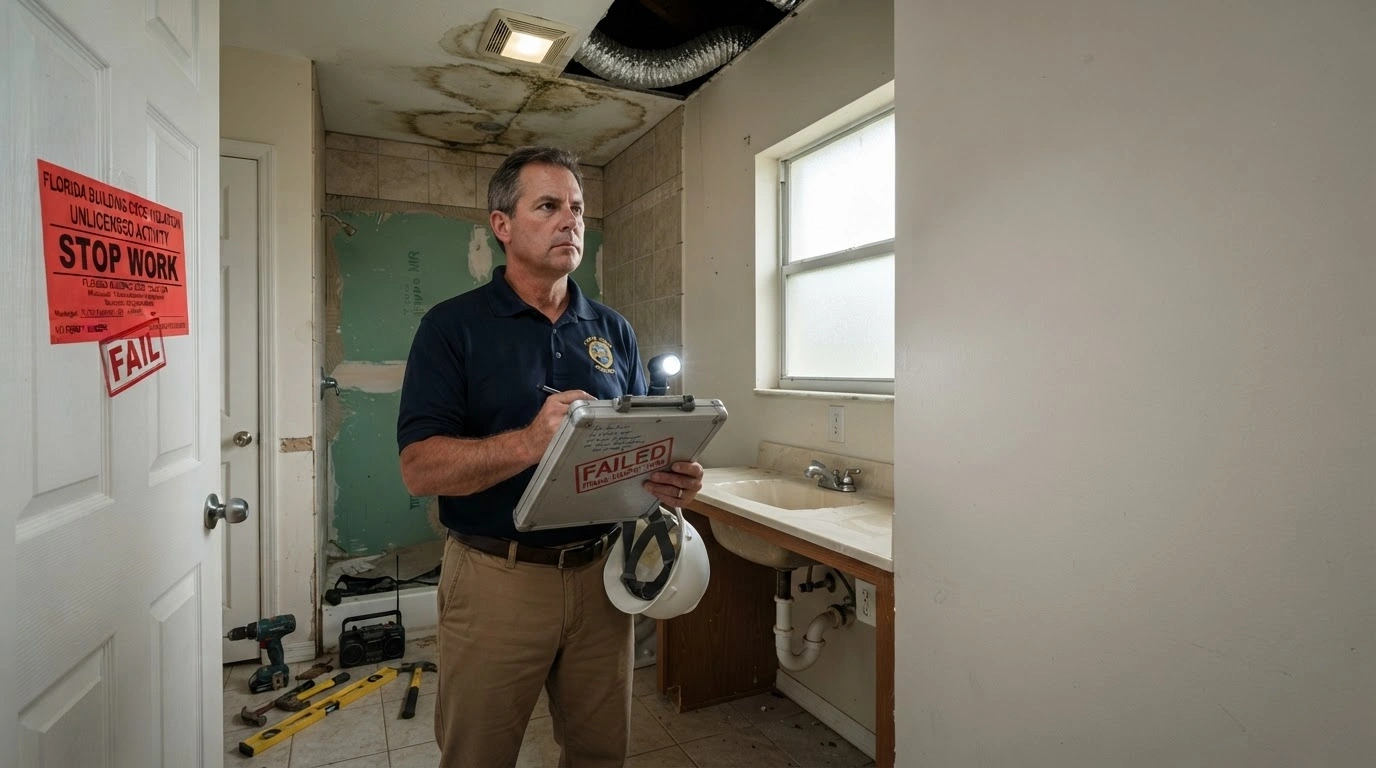
In Florida, an unlicensed contractor is a person or business performing work that requires state contractor certification or registration without holding it. Florida law also treats anyone operating on an inactive or suspended credential as unlicensed. A local business tax receipt is not a contractor license, even though it looks official.
Construction contracting in Florida is regulated under Chapter 489 of the Florida Statutes. Two points in §489.127 matter to homeowners more than the rest. First, a credential that has lapsed, gone inactive, or been suspended does not count - someone can have held a valid license for years and still be unlicensed today. Second, that county or city business tax receipt a contractor may show you is a tax document, not a qualification. The statute says so explicitly.
Certified, registered, and everything else
Florida issues contractor credentials in more than one form, and the distinctions matter when you are checking one:
- State-certified contractors hold a certificate issued by the state and may contract anywhere in Florida, within the scope of their license.
- State-registered contractors are qualified to work in specific local jurisdictions rather than statewide.
- Specialty contractors hold credentials limited to a defined trade or scope. A specialty credential is not a general one, and the classification tells you what that person may lawfully contract for.
- Subcontractors performing work such as plumbing or electrical generally need their own appropriate credentials for that trade - the general contractor’s license does not extend to cover them.
- Some work does not require a state contractor license at all. Licensing depends on the scope of work being performed and on applicable state and local requirements, not on the room the work happens in. Swapping a vanity light fixture and rebuilding a shower are not the same question.
That last point is the one most articles on this subject get wrong, and it cuts both ways: not every person who touches your bathroom needs a contractor license, and not every person who has one is licensed for the scope you are hiring for. If you want the mechanics of reading a credential, we cover it in detail in our guide to how to verify a Florida contractor license step by step.
Is It Illegal to Hire an Unlicensed Contractor in Florida?
Florida law prohibits acting as a contractor, or advertising as available to act as one, without the required registration or certification. Those prohibitions apply to the person doing the contracting, not to the homeowner who hires them. A homeowner’s exposure is usually practical and financial - but it can become legal in an owner-builder permit arrangement.
Under §489.127(1), a person may not engage in the business or act in the capacity of a contractor without being duly registered or certified, and may not advertise themselves as available to do so. Violations are classified as a first-degree misdemeanor, escalating to a third-degree felony for a repeat violation or for a violation committed during a state of emergency declared by the Governor - a provision that exists because of what happens in Florida after hurricanes.
The state can also issue a stop-work order for unlicensed work on a project when it has probable cause to believe work requiring certification or registration is being performed without it. From the homeowner's side, that is not an abstraction. It means the job stops, in your house, with the shower demolished.
Local code enforcement has its own authority to cite unlicensed activity and impose civil penalties. So the pressure on an unlicensed contractor mid-project can come from more than one direction, and none of those directions produce a finished bathroom.
Where the homeowner sits in all this
The prohibitions run to the person doing the contracting. Hiring someone is a different act from being someone. But "not the target of the statute" is a long way from "no exposure," and the practical risks are the substance of this article. There is also one situation where a homeowner takes on real legal responsibility directly: pulling an owner-builder permit for work someone else is actually performing. That has its own section below, because it is the trap we see most often.
The True Cost of Hiring an Unlicensed Bathroom Contractor
Bathrooms are an unforgiving place to learn that a contractor was not qualified. Almost everything that matters is hidden the moment the tile goes on, and water finds mistakes patiently. Here are the seven costs that do not appear on the estimate.
Poor workmanship
The failures we get called to look at cluster in the same places every time: tile that debonds or cracks along a line, shower floors that do not slope properly to the drain so water stands after every use, shower systems that leak at the pan or at a wall penetration, waterproofing that was treated as a coat of something applied at the end rather than a continuous system, drains that run slow because a line was pitched wrong, vanities set on floors that were never leveled, plumbing connections that weep, and materials that fail early because they were never rated for a wet area in the first place.
None of that is exotic. It is what happens when someone competent at the visible parts of the job has not done the invisible parts often enough to know what they cost when they are wrong.
Paying twice for the same bathroom
This is the pattern that makes the cheap bid expensive. A low price wins the job, the work fails somewhere behind the finished surface, and a qualified contractor has to be brought in - not to build a bathroom, but to demolish one and then build a bathroom.
These numbers are illustrative only. They are not quotes, not averages, and not drawn from a real project.
Suppose qualified bids for a primary bathroom come in around $28,000 and an unlicensed bid comes in at $16,000. The homeowner saves $12,000 and the bathroom looks good on completion.
Fourteen months later, staining appears on the hallway side of the shower wall. The shower has to come out. The remediation project is now: demolition of finished work, moisture and mold assessment, repair to framing and substrate, rebuilding the shower properly, and replacing tile that cannot be salvaged or matched. Plus the hallway drywall and paint.
The original $16,000 is unrecoverable. The rebuild costs more than the original correct bid would have, because demolition and remediation are added to it. The "savings" became a premium - and that is before anyone counts fourteen months of a family sharing one bathroom during a second remodel they did not plan for.
Permit and inspection problems
Not every bathroom project requires the same permits. A cosmetic refresh is not the same as a remodel that moves plumbing, alters electrical, or changes the structure - and requirements vary by jurisdiction across Hillsborough, Pinellas, and Pasco counties and the municipalities inside them. What matters is that somebody establishes, in writing and before work starts, what permits the project requires and who is responsible for pulling them. Our guide to what a bathroom remodel actually involves walks through where permitting sits in the schedule.
When permitted work is done without a permit, the problems surface later and land on the property, not on the person who did the work. Unpermitted work can be discovered during a later permit application, an insurance inspection, or a sale. Resolving it can mean opening finished work so an inspector can see what is behind it, corrective work to bring it to code, and delay at the worst possible moment - usually with a buyer waiting.
There is a related warning sign here. A contractor who tells you the job does not need a permit, when it plainly involves moving plumbing or altering electrical, is telling you something about how they work. So is one who asks you to pull the permit yourself.
Water damage, which is the expensive one
Bathroom remodeling is a waterproofing discipline that happens to involve tile. The shower pan, the membrane, how the membrane is tied in at the curb and the wall, the slope to the drain, every penetration where a valve or a fixture passes through a waterproofed surface, and every connection behind the wall - all of it is buried before the job looks finished. This is why we treat shower waterproofing and installation as a system rather than a step.
A failure in that system does not announce itself. Water moves into framing, substrate, and insulation and does its work quietly, often for months. By the time there is a visible stain, a soft spot in the floor, or a smell, the repair is no longer confined to the bathroom. In a Florida climate, with year-round humidity, an assembly that stays damp does not get a dry season to recover in.
That is why the gap between a correctly built shower and a cheap one is so much wider than the gap between the two prices.
Insurance and liability exposure
Someone is going to be working in your home, on ladders, with tools, around plumbing and electrical. Two coverages matter: general liability, which responds to property damage, and workers' compensation, which responds when a worker is injured. If the person doing the work carries neither, the question of who pays becomes a live one.
We are not going to tell you that your homeowner's policy will automatically deny a claim involving an unlicensed contractor. That depends on your policy, your carrier, and the facts, and anyone who tells you otherwise is guessing at your coverage. What we will tell you is that this is a question to ask before work begins, not after.
Ask the contractor for a certificate of insurance sent directly from their insurance agent - not a PDF forwarded from the contractor's phone. Confirm general liability and the workers' compensation position for everyone who will be on your property, including subcontractors.
Then call your own insurance agent, describe the project and who is doing it, and ask what your policy does and does not cover. That five-minute call is the cheapest risk management available on a remodel.
Contract problems, and what Florida law actually says
Insist on a detailed written contract regardless of who you hire. At minimum it should identify the contractor and their credential, define the scope of work, specify materials and allowances, set a payment schedule tied to progress, describe how change orders are handled and priced, state start and completion expectations, and set out warranty terms.
Florida also has a specific provision about contracts with unlicensed contractors, and it is widely misdescribed, so it is worth stating precisely. Under §489.128, contracts entered into by an unlicensed contractor are unenforceable in law or in equity by the unlicensed contractor. The statute also provides that where a contract is unenforceable under that section, no lien or bond claim exists in favor of the unlicensed contractor for labor, services, or materials provided under it.
The statute limits what the unlicensed contractor can enforce against you. It is not a general declaration that the contract is void, and it is not a rule that a homeowner automatically gets their money back or automatically owes nothing.
Two qualifiers in the statute matter as well. If a state license is not required for the scope of work under the contract, the person performing that work is not considered unlicensed for the purposes of that section. And a person or business is not considered unlicensed merely for lacking a local business tax receipt.
How any of this applies to a specific situation depends on the facts, the scope of work, and the timing - and that is a question for a Florida attorney, not for a remodeling company.
Having no practical way to get it fixed
This is the cost homeowners describe most bitterly, and it is the least legal of the seven. A statutory protection is only worth what you can actually collect on it.
If the person who built your shower has no license to place at risk, no insurance to claim against, no business assets, no fixed address you can rely on, and no incentive to answer the phone, then your remedies are theoretical. You may be entirely in the right and still have no realistic path to a repaired bathroom. Regulatory complaint processes exist for licensed contractors precisely because there is a credential in the system that gives them leverage. Where there is no credential, that leverage is missing.
A licensed contractor has something to lose. That, more than anything else in this article, is what you are actually buying.
Before comparing estimates, make sure you are comparing properly credentialed contractors, complete scopes of work, quality materials, real waterproofing systems, permits, and warranties, not just the lowest number. Get Your FREE Estimate or call (656) 232-0999.
Why Is the Unlicensed Contractor’s Estimate So Much Cheaper?
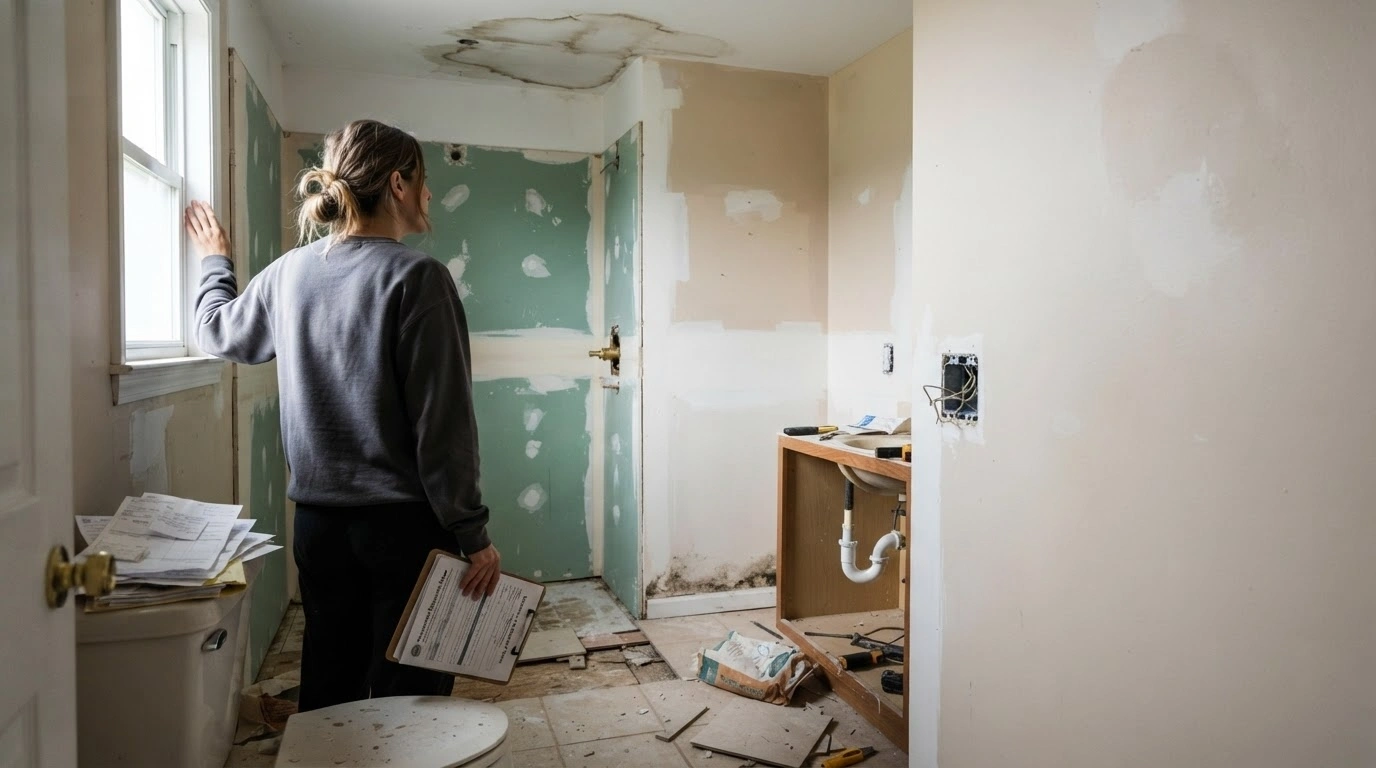
Usually because it is not the same estimate. A lower number can reflect genuine efficiency, lower overhead, or a contractor who wants the work. It can also reflect costs that were simply never included. These are the line items that most often explain a large gap:
- Insurance. General liability and workers’ compensation are real recurring costs carried by a business that has them.
- Licensing and compliance. Maintaining a credential carries its own ongoing cost in fees and continuing education.
- Permits. Permit fees, application time, and waiting for inspections all cost money and schedule.
- Qualified subcontractors. A properly credentialed plumber or electrician costs more than someone who is neither.
- Business overhead. Office, vehicles, software, bookkeeping, taxes, and the staff who answer your calls.
- Project management. Somebody sequencing trades, ordering material on time, and being accountable when something slips is a salaried person, not a free service.
- Quality control. Time spent checking work before it gets covered is time nobody bills the homeowner for directly.
- Materials. Waterproofing systems, setting materials, and fixtures vary enormously in cost, and the difference is invisible in a one-line bid.
- Warranty support. A warranty is a liability the contractor is pricing into the job. A bid with no warranty has priced that at zero.
- Labor. Experienced tradespeople cost more per hour, and generally cost less per project.
A low price is not proof that a contractor is unlicensed, and it is not proof of anything dishonest. Good contractors sometimes bid low - for a slow month, for a project they want in their portfolio, for a neighborhood they are trying to build referrals in. Price tells you nothing reliable about credentials.
The point is not to distrust the low bid. The point is to find out what is in it. Ask each bidder to itemize the same scope, and a gap that looked like a discount often turns out to be a difference in what is being delivered.
Licensed vs. Unlicensed Bathroom Contractor
| Factor | Properly credentialed contractor | Unlicensed contractor |
|---|---|---|
| License / registration | A credential you can verify in the state’s public records | May lack the credential required for the scope of work |
| Permitting | Proper permit process should be followed and documented | Higher risk of work proceeding without required permits |
| Insurance | Coverage you can verify directly with the insurance agent | Coverage may be unclear, partial, or absent |
| Written contract | Detailed written agreement is standard practice | Contract may be minimal, verbal, or incomplete |
| Accountability | Operates within a regulatory framework with a credential at stake | Practical accountability may be very limited |
| Work quality | Still must be verified - a license is not a guarantee | Greater risk that qualifications do not match the scope |
| Warranty | Should be documented in writing and backed by a business | May be promised verbally and difficult to enforce |
| Long-term risk | Generally lower when the contractor is properly vetted | Potentially much higher, and often invisible for months |
Holding a credential means someone met the state’s qualification requirements and has something to lose. It does not mean they are good, that they communicate well, or that they are right for your project. Licensed contractors produce disappointing work too.
Verify the credential then keep vetting. Reviews, references you actually call, proof of insurance, a portfolio of comparable bathrooms, and a contract you have read all the way through. The license is the floor, not the ceiling.
How to Check If a Florida Contractor Is Licensed
Ask for the contractor’s legal business name and license number in writing, then search the Florida Department of Business and Professional Regulation’s free public license records at myfloridalicense.com. Confirm the credential is active, that its classification matches your scope of work, and that the name on the record matches the name on your contract.
Here is the short version. For the full walkthrough including how to read a classification, what each license status means, and how to interpret complaint history see our detailed guide to how to verify a Florida contractor license step by step.
Our Florida license is CGC #1537706. Search it at myfloridalicense.com. We would rather you check than take our word for it and we would encourage you to run the same search on every contractor bidding your project, including the one you already like best.
Red Flags of an Unlicensed or High-Risk Contractor
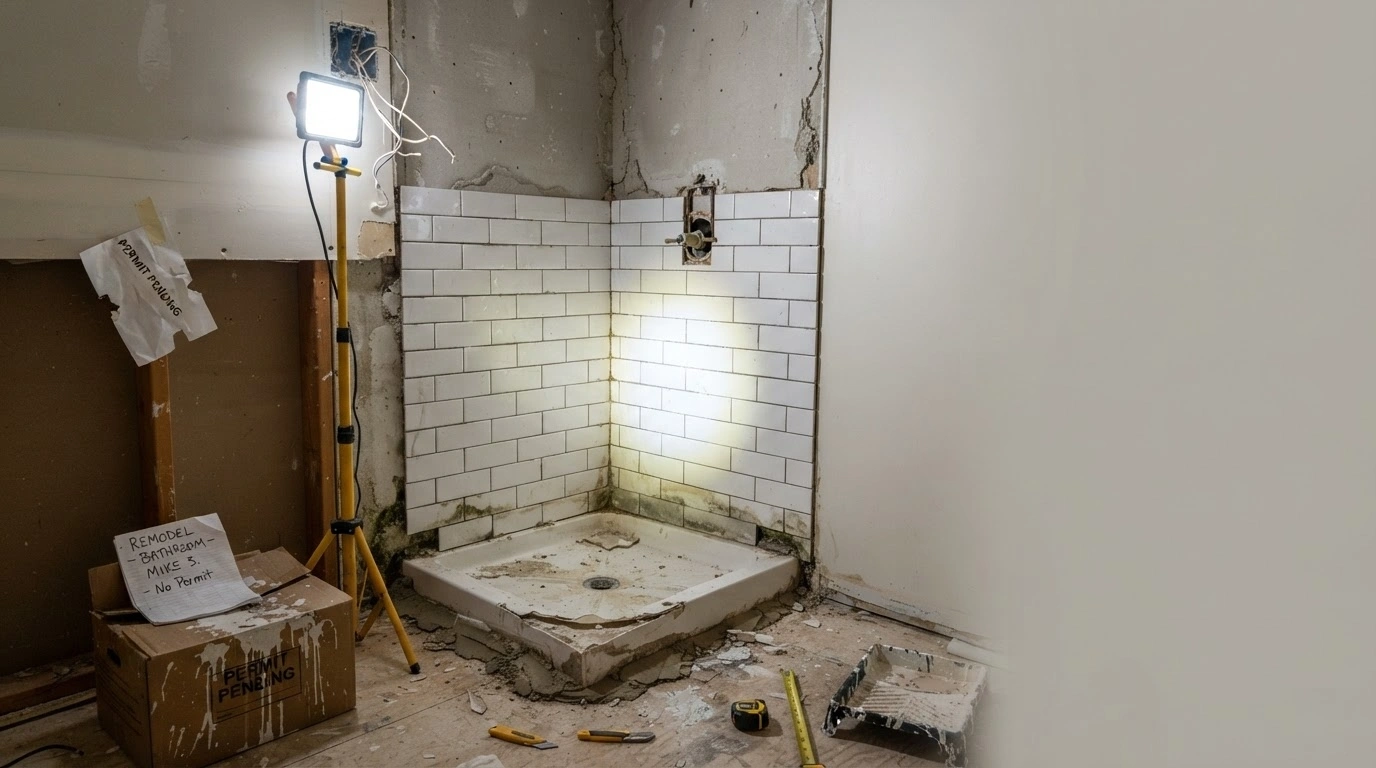
None of these individually proves anything unlawful. Several together is a reason to slow down and verify before money changes hands. We cover the same territory from the kitchen side in our piece on red flags when hiring a contractor.
- "We don’t need a permit for this" for work that clearly involves moving plumbing, altering electrical, or structural change.
- "My friend has a license, we’ll use his." Florida law specifically prohibits a licensed contractor from allowing their credential to be used by someone who is not licensed.
- "I’ll pull the permit under someone else’s license." Same problem, and it also means the person on the permit is not the person doing the work.
- Asks you to pull the permit yourself for work they are actually performing. See the next section, this one is a bigger deal than it sounds.
- Declines or deflects when asked for license information in writing.
- Wants a large cash payment up front, or a deposit disproportionate to the work.
- No written contract, or a one-page document with no scope, no schedule, and no warranty terms.
- No proof of insurance, or a certificate forwarded from the contractor rather than sent by the insurance agent.
- A price dramatically below every other qualified bid, with no explanation of what is different.
- Pressure to decide immediately - a price that expires today, a crew that is "only available this week."
- Cannot produce recent, relevant references for comparable bathroom work.
- Vague business information: no fixed address, a company name that does not match anything you can find, inconsistent contact details.
- Avoids questions about who will actually perform the plumbing and electrical work.
Can a Homeowner Pull a Permit for an Unlicensed Contractor?
Florida’s owner-builder exemption lets property owners act as their own contractor on their own home under specific conditions, including providing direct onsite supervision themselves of all work not performed by licensed contractors. It is not a mechanism for putting a permit in your name so that somebody else can do the contracting.
This is the request we would most like Tampa Bay homeowners to recognize when they hear it, because it sounds like a favor and it is not. Under §489.103(7), the exemption applies to owners of property acting as their own contractor and providing direct, onsite supervision themselves of all work not performed by licensed contractors, for one-family or two-family residences they occupy or use and do not offer for sale or lease. The owner must personally appear and sign the building permit application, and sign a disclosure statement provided by the local permitting agency.
Two sentences inside that subsection are the ones that matter here, and they are unusually direct for a statute:
- The exemption does not exempt any person who is employed by, or has a contract with, the owner and who acts in the capacity of a contractor.
- The owner may not delegate the responsibility to directly supervise all work to any other person unless that person is registered or certified and the work is within the scope of their license.
Read together, those two lines describe exactly the arrangement being proposed when someone asks you to pull the permit while they run the job. The exemption is for owners who are genuinely supervising their own project. It is not a workaround, and treating it as one does not make the arrangement lawful - it just moves the paperwork.
As an owner-builder you are the responsible party of record on the permit. The statutory disclosure statement says this in plain terms, and it goes further: it tells you that you may protect yourself from potential financial risk by hiring a licensed contractor and having the permit filed in their name instead of your own.
The statute also provides that where the requirements of the subsection are violated, the local permitting agency may withhold final approval, revoke the permit, or pursue action or remedy for unlicensed activity against the owner as well as against the person performing work requiring licensure.
So the short answer is this: if you are genuinely building or supervising your own bathroom, the owner-builder route exists for you. If someone else is running the job and simply wants your name on the permit, you would be taking on the responsibility while they take the payment. Decline, and treat the request as the red flag it is.
What Should a Tampa Homeowner Look for in a Bathroom Contractor?
Once the credential checks out, this is the rest of the list. It is the same list we would use ourselves, and it applies to any contractor bidding your project including us. We work across bathrooms, kitchens, and home remodeling across Tampa Bay, and every one of these is something a homeowner is entitled to ask about before signing.
- An appropriate Florida credential for the scope of work, which you have verified yourself.
- Relevant bathroom experience - not general remodeling experience with one bathroom in the portfolio.
- Local project experience in your jurisdiction, so the permitting process is familiar rather than exploratory.
- Insurance confirmed directly with the agent, covering everyone who will be on site.
- A detailed written contract with scope, materials, allowances, schedule, and warranty terms.
- Transparent pricing you can compare line by line against other bids.
- A clear permit process with responsibility assigned in writing.
- References you can call for comparable recent projects - and then actually calling two of them.
- A portfolio of similar bathrooms at a similar scope and budget to yours.
- Documented warranty terms covering labor as well as materials, with a stated duration.
- Clear communication during the bidding process. How someone communicates before they have your money is the best available preview.
- Professional project management - ideally a single named point of contact rather than a rotating cast.
Questions to Ask Before Hiring a Bathroom Contractor
Copy these into your phone and use them on every bid. A contractor who is comfortable with all thirteen is telling you something useful, and so is one who is not.
- Are you properly licensed for this scope of work, and what is the license number and the exact name it is held under?
- May I verify your credential in the state’s public records before we go further?
- Who will pull the permits for this project, and which permits do you expect it to require?
- Who performs the plumbing and electrical work, and are they separately credentialed for it?
- Are all of your subcontractors properly credentialed where required for their trades?
- Can you have your insurance agent send me a certificate of insurance directly?
- Can I see recent bathroom projects at a similar scope and budget to mine?
- Can you provide references from the last six months that I can call?
- What waterproofing system will you use in the shower, and how is it tied in at the pan and the wall penetrations?
- How are change orders handled, priced, and approved once work is underway?
- What is the payment schedule, and what is tied to what milestone?
- What warranty do you provide on labor, and for how long?
- Who manages inspections, and who is my single point of contact if something goes wrong?
How Much More Does a Licensed Bathroom Contractor Cost?
There is no reliable percentage, and anyone who quotes you one is inventing it. What is real is the list of things a professional estimate has to cover that a bare-bones bid may not: labor at experienced rates, insurance, permitting and inspection time, project management, credentialed subcontractors for the trades that need them, materials specified for wet areas, a genuine waterproofing system, code compliance, warranty exposure, business overhead, and the quality control time that keeps mistakes from getting buried under tile.
The practical advice is to compare like with like. Ask every bidder to price the same written scope, with the same allowances, and to state what is excluded. A gap that looked like a discount frequently turns out to be a difference in what is being built. For where bathroom pricing lands at the upper end of the market, see our guide to what bathroom remodels cost at the high end.
Tampa Bathroom Remodeling Considerations
Some of what makes bathroom work unforgiving is specific to where we build.
Humidity and moisture management
Tampa Bay is humid nearly year round. An assembly that traps moisture does not get a dry season to recover in, so ventilation sizing, moisture-tolerant materials, and continuous waterproofing matter more here than they do in a drier climate. A bathroom fan that is undersized or vented into an attic instead of outside is a slow, expensive mistake.
Older Tampa Bay housing stock
Many homes in South Tampa, Seminole Heights, and the older Clearwater and St. Petersburg neighborhoods were built decades ago, on slab, often with concrete block exterior walls. That affects what can be moved, what has to be furred out, what is likely to be found once tile comes off, and what the drain lines are made of. It is also why the bathroom remodeling in South Tampa conversation looks different from a Wesley Chapel or Riverview new-build conversation.
Plumbing and building code
Work that alters plumbing or electrical generally triggers permitting and inspection requirements, and the specifics depend on your jurisdiction. Hillsborough County, the City of Tampa, Pinellas County, and Pasco County each administer this locally. A contractor who works in your area regularly will know the process; one who does not will find out at your expense.
Condominium restrictions
Condo bathroom remodels carry an extra layer. Association rules commonly govern work hours, elevator use, debris removal, floor assemblies, sound transmission requirements, and shutting off water risers - and association approval is separate from, and additional to, any municipal permit. The same is true for kitchen remodeling in a condo. Confirm both sets of requirements before demolition, not after.
Compare Bids Properly, Then Choose With Confidence
The cheapest bathroom bid and the cheapest bathroom are rarely the same thing. The difference between them is usually invisible on the estimate and buried behind tile by the time it matters.
You do not need to become an expert to protect yourself. Verify the credential in the state's public records, get insurance confirmed by the agent, insist on a written scope and warranty, settle permit responsibility before demolition, and call two references. That is an hour of work, and it is the highest-return hour in the whole project.
Remodels by Renov8 Plus is a licensed and insured Florida design-build contractor with more than a decade of bathroom remodeling experience across Tampa Bay - South Tampa, Carrollwood, Westchase, Wesley Chapel, Brandon, Riverview, Lutz, Odessa, Clearwater, and St. Petersburg. Every project gets a written scope, a documented permit plan, and a dedicated project manager as your single point of contact. And we will hand you our license number before you ask for it.
Free in-home consultation · Written scope of work · Licensed and insured · On-time and on-budget guarantee
Call (656) 232-0999 · Visit renov8plus.com/quiz · Email info@renov8plus.com
Remodels by Renov8 Plus · 3750 Gunn Hwy, Unit 306, Tampa, FL 33618 · Florida CGC #1537706