How Do You Pay for a Bathroom Remodel?
Most Tampa Bay homeowners pay for a bathroom remodel one of seven ways: cash or savings, a credit card, a personal loan, a home equity loan, a home equity line of credit (HELOC), contractor-arranged financing, or a specialized home-improvement program. Many people combine two of them. There is no single right answer, because each option carries a different cost, a different repayment structure, and a different level of risk.
The same list applies if you are asking how to pay for a kitchen remodel. What changes is scale. Kitchens usually cost more and run longer, which pushes some homeowners toward larger or longer-term options.
This guide explains how each option works, what it actually costs you over time, and the situations where each one tends to make sense. The goal is not to talk you into borrowing. It is to help you walk into a lender conversation already knowing what to ask.
Remodels by Renov8 Plus is a licensed Florida design-build general contractor (CGC #1537706). We are not a bank, a lender, or a financial advisor.
We can tell you what your project will cost and why. We cannot tell you what a loan will cost you only the lender can, and only in writing. Review complete loan terms with the lender or a qualified financial professional before you borrow anything.
How Much Should You Plan to Finance?

Before you compare loans, you need a real number. Shopping for financing without a defined scope is how homeowners end up borrowing too little and stalling mid-project, or borrowing too much and paying interest on money they never needed.
What actually drives the number
In a bathroom, the cost is driven by the size of the room, whether the layout moves, the tile, the shower or tub, the vanity, the fixtures, the flooring, and the lighting. In a kitchen, cabinetry and countertops usually carry the largest share, followed by appliances, tile, electrical, and plumbing.
Then there are the line items homeowners routinely forget:
- Permits and inspections
- Design services and drawings
- Demolition and disposal
- Electrical work required to bring an older circuit up to current code
- Plumbing rerouting when a fixture moves even a few feet
- Structural work if a wall comes out
- Unexpected conditions found behind the wall rot, failed supply lines, old wiring, or water damage
That last one matters most in a financing conversation, because it is the line item you cannot price in advance. It is also the most common reason a project budget moves after work starts.
Project budget is not the same as the amount you finance
Your project budget is the full cost of the work. The amount you finance is whatever is left after the cash you choose to put in. These are two different numbers, and separating them is the single most useful thing you can do before you talk to a lender.
A worked example of the difference: if the project is $34,000 and you contribute $10,000 in cash, you are financing $24,000 and every loan comparison you run should be against $24,000, not $34,000.
If you are still defining scope, our service pages walk through what is typically included in bathroom remodeling in Tampa and in kitchen remodeling in Tampa.
7 Ways to Pay for a Kitchen or Bathroom Remodel
Here are the main ways to pay for a home remodel, side by side. Each is explained in detail below.
| Method | Best for | Main advantage | Main consideration |
|---|---|---|---|
| Cash / Savings | Homeowners with sufficient savings | No borrowing cost at all | Reduces your cash reserves |
| Credit Card | Smaller purchases or short-term needs | Immediate, convenient access | Interest can be expensive |
| Personal Loan | Homeowners without substantial equity | Often not secured by your home | Rates and terms vary widely |
| Home Equity Loan | Projects with a known, fixed cost | Lump sum, often at a fixed rate | Secured by your home |
| HELOC | Flexible or phased projects | Draw only what you need | Usually a variable rate |
| Contractor Financing | Homeowners who want it handled in one place | Integrated with the project | Terms are set by a third-party lender |
| Other Programs | Eligible homeowners and projects | May offer specialized terms | Qualification rules are narrow |
Paying Cash for a Bathroom or Kitchen Remodel
Paying cash means no application, no interest, no monthly payment, and no lien on your home. If you have the savings and the project is modest relative to what you hold, it is usually the simplest path.
When cash tends to make sense
- The project cost is small enough that paying it does not touch your emergency fund
- You want the project done without adding a monthly obligation
- You want to avoid closing costs, origination fees, and appraisal fees entirely
- Your project scope is firm and unlikely to expand
The part homeowners underweight
Cash has an opportunity cost. Money spent on a remodel is money not sitting in an emergency fund, not invested, and not available for a medical bill, a roof, or a job gap. That is not an argument against paying cash. It is an argument for deciding how much cash, rather than defaulting to all of it.
The cheapest financing may be not borrowing at all but only if paying cash does not leave you financially vulnerable.
There is also a middle path that gets overlooked: combining. Many homeowners pay a portion in cash and finance the rest. That lowers the amount borrowed, shortens the term, and keeps a reserve intact. It is often a better outcome than either extreme.
Using a Credit Card for a Remodel
A credit card is a practical tool for part of a remodel and a poor tool for all of it.
Where a card fits
- Fixtures, hardware, lighting, mirrors, and other finish purchases you are buying yourself
- A small deposit or a single trade item
- Short-term bridging when you know exactly when the money is coming
- A promotional-rate offer you are certain you can clear inside the promotional window
Where it goes wrong
Credit card interest rates are typically the highest of any option on this list. Carrying a five-figure remodel balance on a card while making minimum payments is one of the most expensive ways to finance anything, because minimum payments are structured to keep the account current, not to retire the balance.
If you are using a promotional offer, read what happens on the day it expires. That is covered in detail in the "same as cash" section below, and it is the single most misunderstood piece of consumer financing.
Personal Loans for Home Improvement
A personal loan gives you a fixed lump sum, repaid in fixed monthly installments over a set term. Many personal loans are unsecured, which means the loan is not backed by your home though secured personal loans do exist, so confirm which one you are being offered.
What to look at on a personal loan
- Amount: fixed at closing. If your scope grows, you cannot draw more.
- Rate: commonly fixed, which makes the payment predictable.
- Term: usually shorter than a home equity product. A shorter term means a higher payment but less total interest.
- Credit requirements: approval and rate both depend heavily on your credit profile and income.
- Origination fee: some lenders deduct it from the amount you receive, so you may net less than the loan amount.
- Prepayment: ask whether paying early carries a penalty.
Who it tends to suit
- Homeowners with limited equity recent buyers especially
- Homeowners who do not want their home used as collateral
- Homeowners who want one predictable payment and a firm payoff date
- Projects with a well-defined scope, where the amount is not going to move
Rates, fees, and approval all depend on the lender and on your financial profile. No one can tell you your rate before you apply.
Home Equity Loans for Remodeling
What is a home equity loan?
A home equity loan is a lump sum borrowed against the equity in your home, repaid over a set term. Equity is what your home is worth minus what you still owe on your mortgage. It is often called a second mortgage, because it sits behind your primary mortgage as a second lien on the property.
How it works
- You receive the full amount at closing, in one payment
- The rate is commonly fixed, which makes the monthly payment predictable
- Terms are typically longer than a personal loan
- Closing costs, appraisal fees, and other up-front charges usually apply
- It does not replace your existing mortgage you now have two payments
The risk, stated plainly
Your home is the collateral. If you cannot repay a home equity loan, the lender can foreclose and you could lose your home. That is the trade for the lower rate. Consumer Financial Protection Bureau and Federal Trade Commission guidance on home equity borrowing both lead with this point, and so should any contractor who is honest with you.
A home equity loan tends to fit best when the project cost is known and fixed, the amount is large enough to justify closing costs, and you are confident the payment fits your budget for the full term, not just for the next year.
HELOC for a Bathroom or Kitchen Remodel
What is a HELOC?
A HELOC is a revolving line of credit secured by your home equity. Instead of receiving a lump sum, you get a credit limit you can draw against as you need it, similar in structure to a credit card but backed by your house.
The two phases
Draw period. You can borrow up to your limit. Many plans allow interest-only payments during this phase, which keeps the payment low but does not reduce what you owe. Per CFPB guidance, a draw period commonly runs about ten years.
Repayment period. Borrowing stops and you repay the balance, often over ten to twenty years. Monthly payments are frequently much higher once repayment begins, because you are now paying principal as well as interest. In some plans the entire balance can come due when the draw period ends. This jump is sometimes called payment shock, and it is the risk homeowners most often fail to plan for.
Variable rates
HELOCs usually carry a variable rate. The CFPB is explicit that with a variable-rate plan, your monthly payment can change even if you never draw another dollar. Some lenders offer a fixed-rate conversion option on part of the balance; ask whether yours does, and what it costs.
When a HELOC fits a remodel
- Phased projects bathroom this year, kitchen next year
- Projects where the final cost is genuinely uncertain
- Homeowners who want access to funds over time rather than one lump sum
- Situations where you expect to pay the balance down quickly
Be cautious if a variable payment would strain your budget, or if you would be tempted to make interest-only payments for a decade and arrive at the repayment period still owing the full amount. As with a home equity loan, your home secures the debt. Falling behind puts the house at risk.
Contractor Financing for Kitchen and Bathroom Remodeling
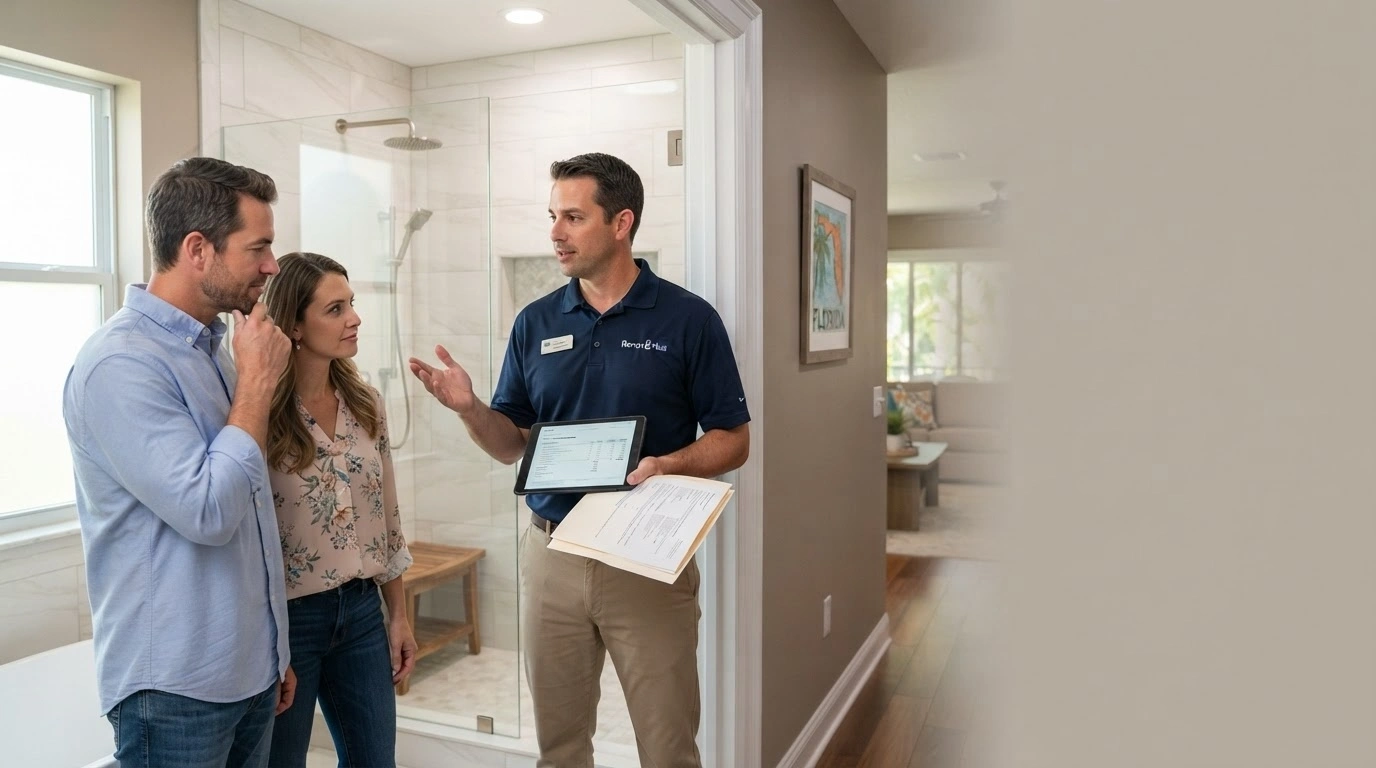
Contractor financing usually means the remodeling company has a relationship with one or more third-party lenders. You apply through the contractor, but the loan is between you and the lender. The contractor is not the one lending you money.
How it typically works
- You apply during or shortly after the estimate, often on a tablet or through a link
- A third-party lender underwrites and approves the loan
- The lender pays the contractor, either in full or on a draw schedule
- You repay the lender directly, on the lender’s terms
What varies
Everything that matters. Product type, APR, term, promotional structures, deferred-payment offers, fees, credit requirements, and approval speed all depend on which lender is behind the program. Two contractors offering "financing" may be offering completely different products.
Who is the actual lender? Not the contractor - the lender’s legal name.
What is the APR, and is it promotional or permanent?
Is this deferred interest, or a true 0% offer? (The next section explains why this question matters more than any other.)
What are the fees, and when do payments begin?
Is financing optional, and does the project price change if I pay cash?
This section describes contractor financing as a general category. It does not describe a Renov8 Plus financing program, and nothing here should be read as an offer, a rate, or a term from us.
If you want to know what payment options are currently available on a Renov8 Plus project, ask us directly and we will tell you exactly what exists and who the lender is. We will not quote you an APR, because we are not the party that sets it.
What Does "Same as Cash" or Promotional Financing Mean?
This is where homeowners get hurt most often, and it comes down to one word.
Look for the word "if"
The CFPB gives consumers a simple test. An offer worded "0% intro APR for 12 months" is a true zero-interest promotion with no interest accrues during the promotional window. An offer worded "no interest if paid in full within 12 months" is a deferred interest promotion, and it works very differently.
How deferred interest actually works
With deferred interest, interest is calculated from the purchase date at the standard rate the whole time. It is simply not charged to your account yet. If you pay the entire promotional balance before the deadline, that accrued interest is waived. If any balance remains - even a small one the full accrued interest is added to your account retroactively.
So a $20,000 remodel financed at 12 months deferred interest, paid down to $500 by month twelve, can result in a bill for twelve months of interest on the whole $20,000. Not on the $500.
The required minimum monthly payment on a deferred-interest plan will usually NOT clear the promotional balance before the deadline. The minimum is calculated to keep your account current, not to pay you off in time.
If you take a deferred-interest offer, ignore the minimum payment. Divide the promotional balance by the number of months in the promotion, and pay that instead. Then confirm with the lender that your extra payments are being applied to the promotional balance and not to another balance on the account.
Promotional structures vary by lender. Some end early if you make a late payment. Some apply a reduced APR rather than zero. Read the agreement, and ask the lender in writing what happens on the day the promotion ends.
Kitchen vs. Bathroom: Which Financing Option Makes Sense?
Project scale changes which options are realistic. This is a starting point for the conversation, not a recommendation your equity, credit, and budget matter more than the project type.
| Project | Financing options worth comparing |
|---|---|
| Small bathroom refresh | Cash, credit card for finishes, or a short-term personal loan |
| Primary bathroom remodel | Personal loan, home equity loan, HELOC, or contractor financing |
| Small kitchen update | Cash or shorter-term financing is often practical |
| Full kitchen remodel | Home equity loan, HELOC, personal loan, or contractor financing |
| Kitchen and bathroom together | HELOC suits phased work; a home equity loan suits a single fixed scope |
| Whole-home remodel | Larger secured options are usually the only realistic route |
Notice that no row says "best." A HELOC that is right for a phased Carrollwood kitchen-and-bath project can be the wrong tool for a single fixed-scope bathroom in Riverview, and the reverse is equally true.
How to Compare Remodeling Financing Offers

Work through these in order. Steps 3 and 5 are the two most homeowners skip, and they are the two that determine what the money actually costs.
- Know the total project cost. Get a written, itemized scope first. A financing decision built on a guess is a guess.
- Decide your cash contribution. Choose the amount that leaves your emergency reserve intact. Subtract it. That remainder is what you are shopping for.
- Compare APR, not monthly payment. APR includes rate plus most fees, which makes it the only number that compares two offers fairly.
- Review the term. A longer term lowers the payment and raises the total cost. Always.
- Calculate total repayment. Multiply the monthly payment by the number of payments. Compare that figure across offers. It is the number that tells the truth.
- Check every fee. Origination, application, appraisal, closing costs, annual fees, early termination fees.
- Understand promotional terms. Deferred interest or true 0%? What is the standard rate afterward? What ends the promotion early?
- Determine whether your home is collateral. Secured or unsecured. This changes what is at risk if something goes wrong.
- Understand variable-rate exposure. If the rate can move, ask how high it can go and how fast. Ask whether there is a rate cap.
- Compare at least two offers. CFPB guidance on home equity lines recommends gathering three estimates. Shopping is the cheapest thing you can do.
For Step 1, our cost guides break down where the money actually goes on what a bathroom remodel costs in Tampa and in this kitchen remodel cost breakdown.
Why Monthly Payment Alone Can Be Misleading
The figures below are an illustrative example only. They use a round hypothetical rate to demonstrate arithmetic. They are not a quoted rate, not an offer, and not a prediction of what any lender would give you.
Take a homeowner financing $30,000 of remodeling work, and assume the same hypothetical 10% APR on both offers. The only thing that changes is the term.
| Illustrative only | Offer A: 5-year term | Offer B: 12-year term |
|---|---|---|
| Amount financed | $30,000 | $30,000 |
| Hypothetical APR | 10% | 10% |
| Monthly payment | About $637 | About $359 |
| Total repaid | About $38,245 | About $51,627 |
| Total interest | About $8,245 | About $21,627 |
Offer B looks better every single month. The payment is about $278 lower, which is real money in a household budget. But over the life of the loan it costs about $13,382 more in interest - close to half the amount originally borrowed.
Neither offer is automatically wrong. A lower payment that you can reliably make can be the right call, especially if the alternative is a payment that strains you into missing one. The point is that you cannot see this difference by looking at the monthly payment, and the monthly payment is what most financing pitches lead with.
Figures are illustrative only and are not based on any current lender rate. Ask any lender for a full amortization schedule showing total repayment before you sign.
Questions to Ask a Remodeling Contractor About Financing
If a contractor offers financing, these are fair questions and a good contractor will answer all of them without hesitation. Print this and bring it.
- Do you offer financing through a third-party lender?
- Who is the actual lender, by legal name?
- Is financing optional, or is it built into this price?
- Does the project price change if I pay cash instead?
- What loan products are available through this program?
- What APR applies to me, and is that promotional or permanent?
- What is the loan term?
- Is any promotional offer deferred interest, or a true 0% APR?
- When does interest begin accruing?
- What happens if the promotional balance is not paid in full by the deadline?
- Are there application, origination, or annual fees?
- Are there prepayment penalties?
- When does my first payment come due?
- How are funds released to you - lump sum or draw schedule?
- Does the financing approval affect my project start date?
- What happens to the financing if the project scope changes mid-build?
That last question matters more than it looks. Change orders are normal on remodels, particularly in older Tampa Bay homes. Knowing in advance whether your financing can accommodate a scope change or whether you would need a separate loan prevents a genuinely bad surprise halfway through.
Financing Red Flags Homeowners Should Watch For
Most contractors who offer financing are running a legitimate third-party program. These are the signals that something is off:
Pressure to sign today.
A financing offer that expires at the end of the sales visit is a sales tactic, not a lending term.
Only the monthly payment is discussed.
If nobody will state an APR, you are not being shown the price.
No written terms.
Verbal financing terms are not terms.
Unexplained fees.
Every dollar should have a name.
Vague promotional language.
"No interest" without the word "if" being explained either way.
Unusually long repayment periods.
A fifteen- or twenty-year term on a small remodel makes the payment look tiny and the total enormous.
Large upfront charges.
Deposits far beyond what materials and mobilization require.
Reluctance to name the lender.
You are entering a contract with them. You are entitled to know who they are.
"Financing is free."
It is not. Someone is paying for it, and the terms will say who.
None of these mean a contractor is dishonest. Some are sloppiness. But every one of them is a reason to slow down and read the paperwork before you sign it.
Tampa Bay Remodeling Financing Considerations
A few things about remodeling here shape the financing conversation in ways that generic national advice misses.
Older housing stock means real budget uncertainty
Much of the housing across South Tampa, Seminole Heights, Clearwater, and St. Petersburg predates current code cycles. Opening a wall in a 1950s bathroom can reveal cast iron drain lines at the end of their service life, ungrounded wiring, or slow-leak damage nobody knew about. None of that is exotic. It is normal, and it is why the flexibility of a line of credit appeals to some homeowners while others prefer the certainty of a fixed lump sum plus a cash contingency.
Permits and inspections are part of the number
Permitting requirements and fees vary between the City of Tampa, Hillsborough County, Pinellas County, and the smaller municipalities. Whether you are in Brandon, Riverview, Lutz, Odessa, Wesley Chapel, or Largo, permit costs and inspection timelines belong in the project budget before you decide what to finance.
Equity levels vary widely by how long you have owned
Homeowners who bought a decade ago often have substantial equity, which puts home equity products genuinely on the table. Homeowners who bought recently may have very little, which is exactly the situation personal loans exist for. Where you sit on that curve determines which half of this article applies to you.
Storm hardening and PACE - read this carefully
Florida’s PACE program (Property Assessed Clean Energy) finances qualifying improvements through an assessment on your property tax bill, with approval weighted toward home equity rather than credit score. It is genuinely useful for the projects it covers impact windows and doors, roofing, HVAC, and other hurricane-hardening and energy-efficiency work.
It is not general remodeling financing. A standard kitchen or bathroom remodel is not PACE-eligible. If your project includes qualifying work, say, impact windows as part of a larger renovation only that portion may qualify.
The assessment sits in a first-lien position ahead of your mortgage and stays with the property. Some mortgage lenders require it to be paid off before they will refinance, and conventional loans generally require payoff at sale. Since SB 770 took effect in July 2024, each Florida county must authorize PACE before residents can use it to confirm your county participates.
Renovation mortgages
If you are buying a home that needs work, or refinancing one you already own, an FHA 203(k) renovation mortgage rolls the purchase or refinance and the renovation budget into a single loan. The Limited 203(k) caps rehabilitation costs at $75,000 and covers non-structural work which includes kitchen and bathroom remodeling. The Standard 203(k) handles structural work and requires a minimum of $5,000 in improvements plus a HUD consultant. Both are subject to county FHA loan limits. Ask a lender who regularly handles renovation financing; not all of them do.
We work with homeowners on kitchen remodeling in South Tampa and on remodeling across Tampa Bay, and the budget conversation looks different in every neighborhood for exactly these reasons.
Should You Finance a Bathroom Remodel?
Here is a straight framework. It is not personalized advice, and it is not a substitute for talking to someone qualified about your specific finances.
Financing may be worth considering when
- The work is necessary rather than purely cosmetic an active leak, a failing shower pan, an unsafe layout
- Your income comfortably absorbs the payment with room left over
- The terms are clear, in writing, and you have compared at least two offers
- You want to preserve your emergency reserve rather than spend it down
- The project is genuinely too large for available cash and delaying it makes it more expensive
Reconsider borrowing when
- The monthly payment would strain your budget in a normal month, let alone a bad one
- The total repayment figure is dramatically higher than the amount borrowed
- You already carry significant debt
- The plan depends on income you expect but do not yet have
- Taking the loan would leave you with no emergency reserve at all
If several items on the second list apply, the useful move is usually not a different loan. It is a smaller first phase. A well-executed bathroom this year and a kitchen in eighteen months beats a stretched loan on both. Phasing is a legitimate strategy, and any contractor worth hiring will help you scope it that way.
This is part of what we work through with homeowners during our design-build remodeling process scope and budget first, before anyone talks about how to pay for it.
How to Pay for a Bathroom Remodel: Quick Answer
Start With the Number, Not the Loan
Every homeowner we meet who is stressed about paying for a remodel has the sequence backwards. They are shopping for financing before they know what the project costs. That is how people end up borrowing the wrong amount on the wrong terms.
Do it in this order instead:
- Define what you actually want changed, and what can wait.
- Get a real, itemized project cost from a licensed contractor.
- Decide how much cash you can contribute without touching your reserve.
- Compare financing offers for the remainder on APR and total repayment, from at least two sources.
- Talk to a lender or a qualified financial professional about the terms.
We can do step two. Remodels by Renov8 Plus has spent more than a decade remodeling kitchens and bathrooms across Tampa Bay as a state-certified design-build general contractor (CGC #1537706), and every project runs through one dedicated project manager from design to final walkthrough. We will give you an honest scope and an honest number, with no obligation attached to it.
What we will not do is tell you how to borrow. That is the lender’s job, and a good contractor knows the difference.
Call: (656) 232-0999
Email: info@renov8plus.com
Visit: 3750 Gunn Hwy, Unit 306, Tampa, FL 33618
Hours: Mon–Fri 9AM–7PM | Sat 10AM–3PM | Closed Sunday
Licensed Florida General Contractor: CGC #1537706
Get your free estimate - no pressure, no obligation, and a clear number you can build a plan around.