

If you have gathered quotes for a kitchen or bathroom project in Tampa Bay, you have probably seen the phrase “state-certified general contractor” on a business card, a truck door, or a proposal. Most homeowners nod at it and move on. It is worth slowing down for, because it is one of the few claims a contractor makes that you can check yourself in about two minutes.
A state-certified general contractor in Florida is a contractor who holds a certificate of competency issued by the state, which allows them to contract in any jurisdiction in Florida within the scope of their license subject to Florida law, permitting rules, and the Florida Building Code.
That one sentence carries three separate ideas: the license comes from the state rather than a city or county, it covers the whole state, and it is limited to a defined scope of work. This guide walks through each one in plain language, then shows you exactly how to verify any contractor’s license before you sign anything.
We are a Tampa remodeling company, and we hold a Certified General Contractor license ourselves. So take this for what it is: a working explanation from people who deal with Florida licensing and permitting every week. Where something is a legal requirement, we say so and point to the source. Where something is our recommendation as remodelers, we say that too.
What Is a State-Certified General Contractor in Florida?

Florida regulates construction contracting under Chapter 489 of the Florida Statutes. The licensing itself is administered by the Florida Department of Business and Professional Regulation (DBPR) through the Construction Industry Licensing Board (CILB).
“State-certified” means the state issued the license
Under Florida law, a certified contractor is one who holds a certificate of competency issued by the department and who may contract in any jurisdiction in the state without having to satisfy separate local competency licensing in each one. In everyday terms: the credential travels with the contractor across county lines.
Getting there is not a formality. Florida requires applicants to document qualifying construction experience, pass a state examination, submit fingerprints for a background check, and demonstrate financial responsibility before the state issues the certificate. Certified licenses then renew on a two-year cycle with continuing education required. The specific hours, fees, and deadlines are set by statute and rule and do change, so treat DBPR as the current authority rather than any article, including this one.
“General contractor” describes the scope
Florida law defines a general contractor as a contractor whose services are unlimited as to the type of work they may do, and who may contract for any activity requiring licensure under that part of the statute. General contractors sit in what the statute calls Division I, alongside building contractors and residential contractors in three separate classifications with different scopes.
This is the part homeowners most often miss. “Licensed” is not one thing. A Certified General Contractor (CGC), a Certified Building Contractor (CBC), and a Certified Residential Contractor (CRC) are all state-certified, and all three are legitimate, but their scopes differ. So do the scopes of specialty licenses such as plumbing, electrical, roofing, or mechanical. What a contractor may lawfully contract for depends on their classification.
Why a company license matters too
A license is held by a person. When that person operates through a corporation or LLC, Florida requires the business to be qualified through that licensee, the qualifying agent so the company itself is authorized to contract. When you verify a license, it is worth confirming that the business you are actually signing with is the business tied to the license, not just that some individual somewhere holds one.
State-Certified vs. Registered Contractor in Florida
Florida issues contractor credentials at two levels, and the difference is geographic. A registered contractor is not an unlicensed contractor. A registered contractor has a local certificate of competency and is registered with the state to work in the jurisdictions where that local credential is held.
| Factor | State-Certified Contractor | Registered Contractor |
|---|---|---|
| Licensing authority | The state DBPR, through the Construction Industry Licensing Board | A local jurisdiction issues the competency credential; the contractor registers it with the state |
| Geographic scope | Statewide | Limited to the jurisdiction(s) covered by the local credential |
| Where they can work | Any jurisdiction in Florida, within the scope of the license | Only where they hold the local credential; expanding means registering elsewhere |
| Local requirements | Still must follow local permitting and code administration everywhere they work | Local competency requirements apply on top of state registration |
| Homeowner considerations | One license to verify; useful for projects spanning counties | Confirm the credential actually covers the county or city where your home sits |
Tampa Bay is stitched together from several jurisdictions - Hillsborough, Pinellas, and Pasco counties, plus municipalities like Tampa, Clearwater, St. Petersburg, and Largo, each administering permits locally. If you hire a registered contractor, confirm their credential covers the specific jurisdiction your property falls under. With a state-certified contractor, statewide authority is built in - though local permitting rules still apply everywhere.
What Can a Florida General Contractor Do?
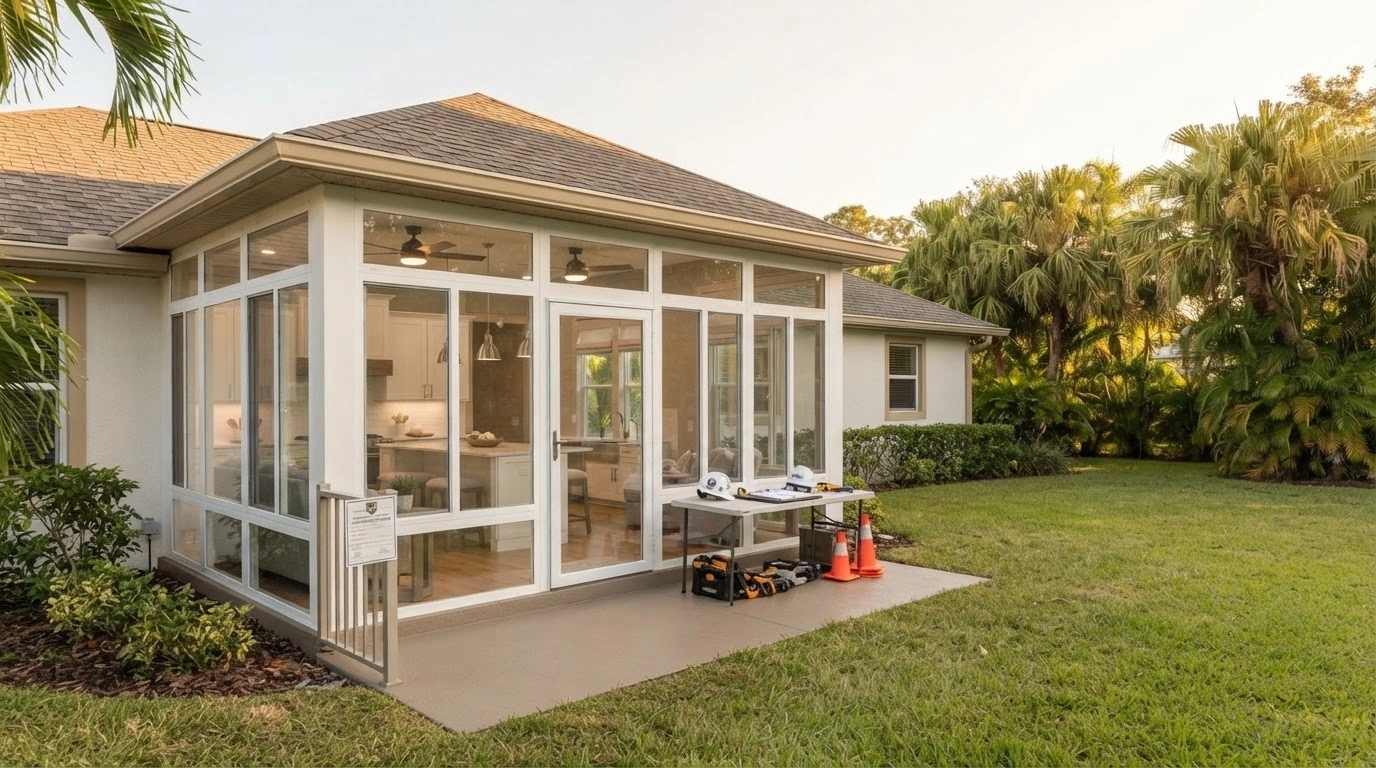
For residential remodeling, a general contractor is typically the party who takes responsibility for the whole project: the permit, the schedule, the trades, the inspections, and the finished result. Work commonly handled under a general contractor includes:
- Kitchen remodeling - layout changes, cabinetry, countertops, and the plumbing and electrical coordination that comes with them
- Bathroom remodeling - shower and tub reconfiguration, waterproofing, tile, fixtures, and ventilation
- Whole-home renovations - multiple rooms and multiple trades moving on one schedule
- Additions and expansions - new square footage, second stories, garage conversions, enclosed patios
- Structural modifications - removing or altering load-bearing walls to open up a floor plan
- Interior renovations - flooring, millwork, built-ins, finish carpentry
- Coordination of licensed subcontractors - plumbing, electrical, mechanical, and other trades working under one contract
One important qualifier: the exact work a contractor may perform depends on their license classification and on applicable Florida law. Certain trades require their own separate licenses, and a general contractor engages appropriately licensed subcontractors for that work rather than performing it under the general license. If you are unsure whether a scope of work fits a given license, DBPR is the place to confirm it.
Most of what we do at Renov8 Plus falls squarely in this territory bathroom remodeling in Tampa, kitchen remodeling in Tampa, and full-home renovations across Tampa Bay which is precisely why the general classification is the right one for design-build remodeling work.
Why Contractor Licensing Matters to Florida Homeowners
Licensing is not a quality rating. It does not promise beautiful tile work or a contractor who returns calls. What it does provide is a verifiable baseline and a place to go when something goes wrong. Specifically:
- Verified qualifications. Someone other than the contractor confirmed their experience, tested their knowledge, and ran a background check before issuing the credential.
- Accountability. Licensed contractors are subject to state disciplinary processes. There is a regulator with jurisdiction over them, and a public record of formal action.
- Proper permitting. Permits for work requiring licensure are generally pulled by the licensed contractor, which keeps the work inside the inspection system rather than outside it.
- Building-code compliance. Permitted work is inspected against the Florida Building Code. That inspection record is what a future buyer, appraiser, or insurer will look for.
- Contract standing. Florida law makes contracts entered into by an unlicensed contractor unenforceable by that contractor, and blocks lien and bond claims in their favor. That is a meaningful structural difference, though it is a poor consolation prize compared with simply hiring correctly.
- A narrower risk pool. Licensing filters out the operator who cannot document experience, pass an exam, or clear a background check.
A license confirms that a contractor met the state’s requirements to hold that credential. It does not guarantee workmanship, schedule performance, communication, or cleanliness. Verify the license first then evaluate references, contracts, and how the contractor actually treats you during the estimate. The license gets a contractor onto your shortlist. It should not be the reason they win the job.
How to Verify a State-Certified General Contractor in Florida
Before hiring a contractor, homeowners should verify the license directly with the state rather than relying on a logo, a license number printed on a proposal, or a screenshot. DBPR maintains a free public license search at myfloridalicense.com. Here is the sequence we recommend.
Request the license number and the exact name it is held under. A contractor who is properly licensed will hand this over without hesitation we put ours in the first paragraph of this article.
Go to myfloridalicense.com and use the licensee verification search. You can search by license number, by name, or by city and county if you only have partial details.
You are looking for an active, current license. Statuses such as delinquent, inactive, suspended, or null mean the credential is not currently in good standing, and that is a stop-and-ask moment, not a technicality.
Confirm the classification matches the work you are hiring for. A specialty license is not a general license, and the classification tells you what the contractor may lawfully contract for.
The DBPR licensee detail record can show complaint and disciplinary entries. Note the limitation: Florida law keeps certain complaints confidential until a probable cause panel finds a likely violation, so a clean record means nothing has been substantiated not that nothing is pending.
Check that the company you are contracting with is the entity qualified under that license. The name on the contract, the name on the license record, and the name on your deposit check should line up.
Licensing and insurance are two different things. Ask for a certificate of insurance sent directly from the insurance agent, and confirm general liability coverage and the workers’ compensation position for everyone who will be on your property.
Establish in writing who pulls the permit and who schedules inspections. For work that requires a permit, that responsibility normally sits with the licensed contractor.
Our Florida license is CGC #1537706. Search that number at myfloridalicense.com and you should see an active Certified General Contractor record. We would rather you check than take our word for it and we would encourage you to run the same search on every contractor bidding your project, including the ones you like best.
If a search turns up nothing, do not assume the worst immediately. Confirm the spelling, try the license number directly, and remember that a legitimate registered contractor may appear differently than a certified one. If it still cannot be verified, DBPR operates a Customer Contact Center and a separate reporting line for unlicensed activity.
What to Ask a Florida General Contractor Before Hiring
Bring this list to your estimated appointment. Good contractors expect these questions. The reaction you get is nearly as informative as the answers.
- Are you state-certified in Florida, or registered?
- What is your license number, and what name is it held under?
- What is your license classification?
- Is the license currently active, and when does it renew?
- Is the company I am signing with qualified under that license?
- What insurance do you carry, and can the certificate come directly from your agent?
- Who pulls the permits for this project you or me?
- Do you use licensed subcontractors for plumbing, electrical, and mechanical work?
- Can you provide recent references for projects like mine?
- What exactly is included in the contract, and what is excluded?
- How are change orders priced, documented, and approved?
- What is the realistic timeline, and what typically causes it to slip?
- What warranty do you provide, and what does it actually cover?
- Who is my day-to-day point of contact once work starts?
One answer deserves special attention: if a contractor suggests that you pull the permit as the homeowner for work they are performing, ask why. Florida provides a limited owner-builder path for people genuinely doing their own work on their own property, but it shifts responsibility onto you and it is a well-known workaround for contractors who cannot pull the permit themselves.
Red Flags When Hiring a Florida Contractor
None of these is proof of a problem on its own. Two or three together is a pattern.
- Won’t provide a license number. There is no good reason to withhold it.
- License information does not verify. The number does not match, the name is different, or nothing comes up.
- Pressure to sign today. Discounts that expire at the end of the appointment are a sales technique, not a price.
- Large cash demands up front. Be cautious of large deposits, cash-only terms, or payment schedules front-loaded well ahead of the work.
- Vague contracts. No detailed scope, no materials specified, no allowances, no schedule of values.
- No proof of insurance, or a certificate that comes from the contractor rather than the agent.
- Asking you to pull the permit for work they are performing.
- Unclear subcontractor arrangements. You should know who is responsible for the trades and how they are paid.
- A bid far below everyone else. In remodeling, the outlier low bid usually means something was left out, and you will meet it again as a change order.
- No physical local presence. A verifiable Florida address matters.
Does a Homeowner Need a General Contractor for a Remodeling Project?
Not for everything. The honest test is how many trades are involved, whether the structure is being altered, and whether a permit is required.
A general contractor usually makes sense for:
- Kitchen remodeling, where cabinetry, plumbing, electrical, flooring, and finish work all have to land in the right order
- Bathroom remodeling that moves fixtures, alters the shower footprint, or touches waterproofing
- Whole-home renovations running several trades on one schedule
- Structural modifications, including load-bearing wall removal
- Additions, second stories, and garage conversions
- Any project that is permit-heavy or inspection-heavy
A specialty contractor may be the better fit for:
- Single-trade work a water heater swap, a panel upgrade, a roof replacement
- Flooring-only installation with no structural or plumbing changes
- Cosmetic updates such as painting or hardware
- Repairs isolated to one system, handled by the licensed trade for that system
The middle ground is where homeowners get into trouble. A bathroom refresh that starts as “just new tile” becomes a licensed project the moment the shower pan is rebuilt or a wall gets opened. If you are unsure which side of the line your project sits on, ask before demolition starts not after an inspector asks about a permit.
How Licensing Applies to Tampa Bay Remodeling Projects
State licensing sets who may contract. Local building departments still administer permits and inspections. Both apply to your project, and it helps to keep them separate in your head.
Permitting is local
A state-certified contractor can work anywhere in Florida, but the permit is pulled from the authority with jurisdiction over your address which in Tampa Bay might be the City of Tampa, Hillsborough County, Pinellas County, Pasco County, or a municipality such as Clearwater, St. Petersburg, or Largo. Submittal requirements, review times, and inspection scheduling vary between them. Ask any contractor bidding your project whether they routinely pull permits in your specific jurisdiction.
The Florida Building Code applies statewide
Florida adopts a statewide building code that local departments administer. For remodeling, this shows up in the details: how a shower is waterproofed, how a bathroom is ventilated, what happens when a load-bearing wall comes out, and how electrical work is brought up to current requirements when a space is opened up.
Wind, water, and Florida-specific conditions
Tampa Bay construction carries considerations that inland markets do not. Wind-resistance requirements affect openings and structural connections. Flood-zone rules can affect what is permitted and how. Humidity is relentless, which makes moisture detailing in bathrooms and kitchens a durability issue rather than a finish preference. These are exactly the areas where permitted, inspected work pays for itself years later.
Older homes across the Bay area
A 1920s bungalow in Seminole Heights, a 1950s block ranch in Carrollwood, and a 1990s build in Wesley Chapel each hide different surprises: original wiring, cast-iron drain lines, unpermitted prior additions, settled framing. Opening walls in an older home reliably reveals something. A licensed contractor with local experience prices for that possibility and handles it through a documented change order instead of an awkward conversation on your kitchen floor.
We work with homeowners across the Tampa Bay area South Tampa, Carrollwood, Westchase, Brandon, Riverview, Lutz, Odessa, Clearwater, and St. Petersburg and the permitting rhythm genuinely differs from one to the next.
State-Certified General Contractor in Florida: Quick Answer
A state-certified general contractor in Florida holds a certificate of competency issued by the Florida Department of Business and Professional Regulation and may contract in any jurisdiction in the state, within the scope of the license. Certification requires documented experience, a state exam, a background check, and proof of financial responsibility. Homeowners can verify any Florida contractor license free at myfloridalicense.com.
Editorial Note
Florida contractor licensing rules, classifications, renewal cycles, fees, and continuing-education requirements are set by statute and administrative rule, and they change. This guide reflects our understanding as practicing Florida remodelers and is written for general homeowner education; it is not legal advice.
For current requirements, consult the Florida Department of Business and Professional Regulation, the Construction Industry Licensing Board, and Chapter 489 of the Florida Statutes directly. For questions about your specific project, consult your local building department and, where the stakes warrant it, a Florida construction attorney.
Planning a Remodel in Tampa Bay?
If you are weighing a kitchen, bathroom, or whole-home project, the licensing question is worth settling early before deposits, before demolition, and before anyone is standing in your house with a reciprocating saw.
Remodels by Renov8 Plus is a Tampa design-build remodeling company holding Florida license CGC #1537706. We handle design, permitting, trade coordination, and inspections as one contract, and every project gets a dedicated project manager so you have one person to call. If it is useful, we are also happy to walk you through what your project will actually require from a permitting standpoint whether or not you end up hiring us.
Request a free remodeling estimate or call (656) 232-0999.
Remodels by Renov8 Plus - 3750 Gunn Hwy, Unit 306, Tampa, FL 33618 · info@renov8plus.com
Florida License CGC #1537706 · Serving Tampa, South Tampa, Carrollwood, Westchase, Wesley Chapel, Brandon, Riverview, Lutz, Odessa, Clearwater, and St. Petersburg.
Explore our remodeling services in Tampa.