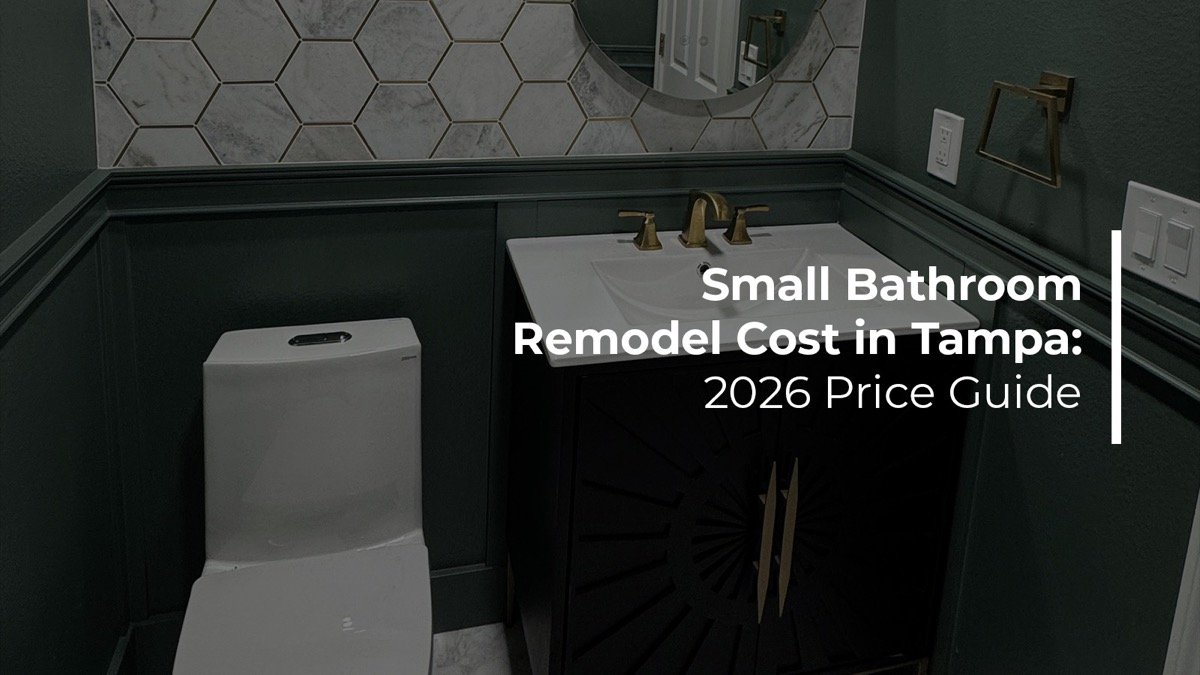
If you have been searching for what a small bathroom remodel costs in Tampa, you have probably already noticed the problem: the numbers are all over the place. One site says $6,500. A neighbor in Carrollwood says they spent $22,000. A contractor quotes $14,000 and another quotes $9,000 for what sounds like the same bathroom.
None of those numbers is necessarily wrong. They are describing different projects.
Most small bathroom remodels in Tampa run about $8,000 to $20,000 in 2026. A cosmetic refresh can land near $4,000. A premium small bath with custom tile and frameless glass can pass $30,000. What moves a project from one end of that range to the other is not the size of the room, it is how much of the room you tear out, what you put back in, and what the crew finds behind the walls.
That last part matters more in Tampa than it does in most markets. Florida humidity, slab-on-grade construction, cast-iron and galvanized plumbing in older homes, and decades of marginal waterproofing behind fiberglass surrounds all mean that Tampa bathrooms hide more surprises than the national averages account for. This guide breaks down real 2026 planning ranges, what each price tier actually buys, where permits come into play, and where you can cut without regretting it in three years.
Quick Answer: How Much Does a Small Bathroom Remodel Cost in Tampa?
A small bathroom remodel in Tampa typically costs $8,000 to $20,000 in 2026. Cosmetic refreshes start near $4,000, mid-range remodels most commonly land between $12,000 and $20,000, premium remodels run $20,000 to $30,000, and luxury small baths can exceed $30,000. Actual pricing depends on project scope, material selections, plumbing and electrical work, existing conditions behind the walls, permitting, and each contractor's specification. These are planning estimates, not quotes.
2026 Tampa small bathroom cost tiers
| Remodel level | Planning range | What it generally covers |
|---|---|---|
| Budget / cosmetic refresh | $4,000 – $9,000 | Same layout, same plumbing locations. New stock vanity, toilet, mirror, light fixture, paint, and either a new floor or a tub reglaze. Little or no tile work. |
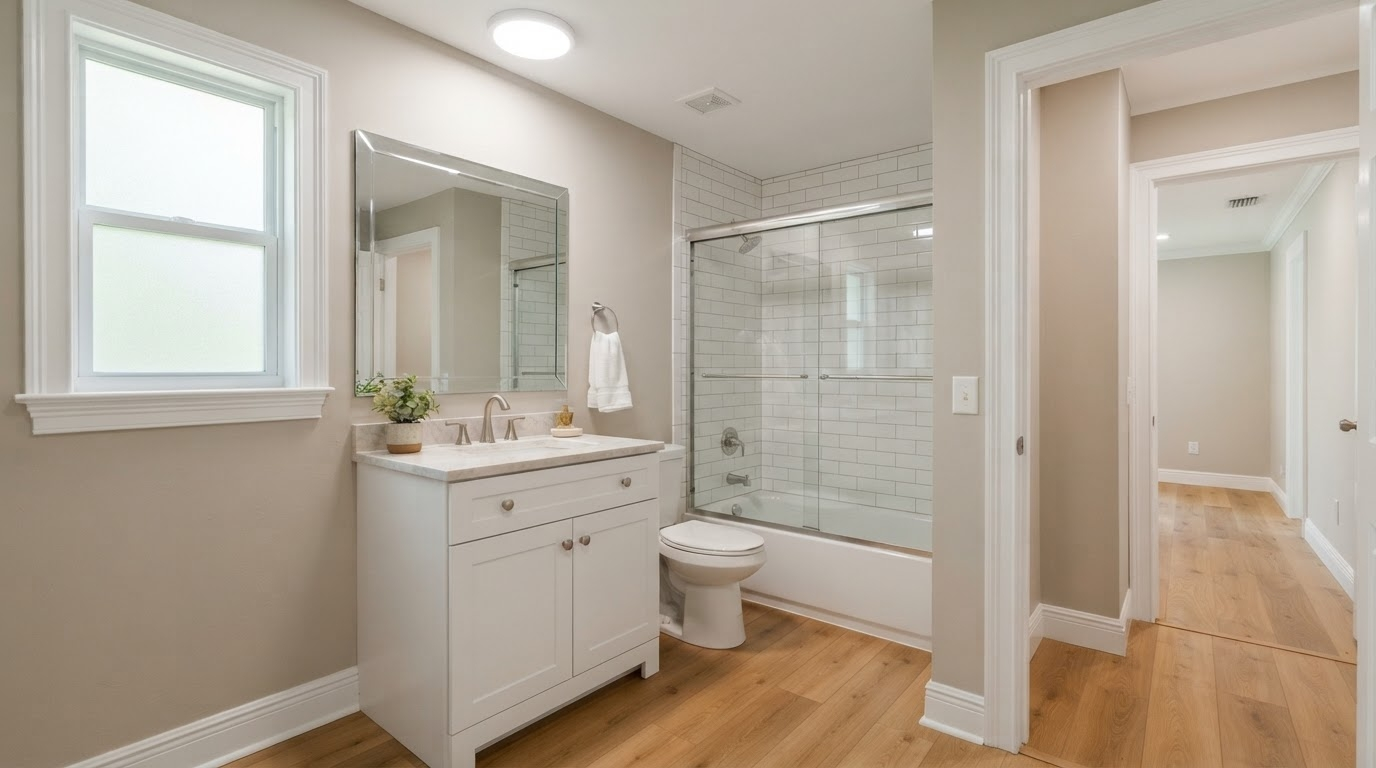
| Mid-range remodel | $12,000 – $20,000 | Full demolition to studs. New tiled shower or tub surround, new floor tile, new vanity and top, new fixtures, new lighting and exhaust fan, fresh waterproofing. Layout stays put. |
| Premium remodel | $20,000 – $30,000 | Everything above plus large-format or patterned tile, semi-custom or custom vanity, quartz top, frameless glass, upgraded fixtures, niche and bench detailing, and often minor plumbing relocation. |
| Luxury small bath | $30,000+ | Custom cabinetry, designer fixtures, book-matched or natural stone, curbless entry, heated floors, integrated lighting, and layout changes that move plumbing. |
Planning estimates for Tampa Bay in 2026. Not a quote. Every project is priced after an in-home assessment of existing conditions.
Why published averages look lower
You will find national and metro-level data putting a small Tampa bathroom around $6,500, with Angi reporting a Tampa small-bath average of roughly $6,559 across a $1,514 to $15,135 range, and a broader Tampa bathroom average near $9,491. Those figures are real, but they blend fixture swaps, partial refreshes, and handyman work into the same average as permitted, code-compliant renovations.
For context, national 2026 data from This Old House puts a typical bathroom remodel between $6,456 and $24,715 with an average near $15,586, while Block Renovation places the national average around $16,500 and small bathrooms under 50 square feet at $6,000 to $15,000 for mid-range work. When a licensed contractor tears a Tampa bathroom to the studs, pulls permits, rebuilds the waterproofing, and installs tile, the realistic starting point is higher than the aggregator average - because the aggregator average is not describing that project.
Key Takeaways
- Most Tampa small bathroom remodels cost $8,000 to $20,000 in 2026, with mid-range projects clustering between $12,000 and $20,000.
- Small does not mean cheap. Demolition, plumbing, electrical, waterproofing, and permits are largely fixed costs that do not shrink with square footage.
- Labor is usually the biggest line item, commonly 40 to 50 percent of the total. Materials are where you have control; labor is where the market sets the price.
- Keeping the existing plumbing layout is the single largest cost lever. Moving a toilet, shower drain, or vanity drain commonly adds $1,000 to $5,000 per fixture relocated.
- Budget a 10 to 20 percent contingency. In Tampa's older housing stock, water damage, rotted subfloor, and dated wiring show up often enough that a contingency should be assumed, not hoped against.
- Permit requirements depend on scope, not on the word "remodel." Work touching plumbing, electrical, mechanical, or structure generally requires one; cosmetic updates generally do not.
- Waterproofing, ventilation, plumbing quality, and electrical safety are never the place to save money especially in Florida humidity.
- Mid-range remodels return the most at resale. The 2025 Cost vs. Value Report put midrange bath remodels at roughly 80 percent of cost recouped nationally, versus about 45 percent for upscale projects.
Small Bathroom Remodel Cost Breakdown by Component
Understanding Tampa bathroom renovation cost at the line-item level is what lets you compare two estimates honestly. A quote that looks $4,000 cheaper is usually cheaper somewhere specific and that somewhere is worth finding before you sign.
The ranges below reflect a small bathroom of roughly 35 to 60 square feet, installed by a licensed contractor, including labor unless noted. Tile and material costs draw on current national and Tampa-area pricing data; installation labor reflects Tampa Bay market rates.
| Component | Estimated cost range | Main cost factors |
|---|---|---|
| Demolition & disposal | $500 – $1,800 | Tile removal, cast-iron tub removal, dumpster or haul-off fees, whether the floor comes up |
| Vanity (unit only) | $400 – $4,500+ | Stock vs. semi-custom vs. custom; width; floating vs. floor-mounted; wood species and finish |
| Countertop | $300 – $2,000 | Cultured marble vs. quartz vs. natural stone; edge profile; integrated vs. undermount sink |
| Toilet (supplied & set) | $300 – $1,600 | Standard two-piece vs. one-piece vs. wall-hung; comfort height; bidet seat |
| Shower or tub assembly | $3,000 – $12,000 | Prefab surround vs. fully tiled; pan construction; niche and bench; curbless entry |
| Tile (material) | $2 – $50 per sq ft | Ceramic at the low end, porcelain mid-range, natural stone and specialty tile at the top |
| Tile (installation labor) | $8 – $20 per sq ft | Layout complexity, large-format flatness prep, herringbone and mosaic patterns, wall vs. floor |
| Flooring | $800 – $3,000 | Porcelain tile vs. luxury vinyl; subfloor prep; whether the old floor must be removed |
| Plumbing | $800 – $5,000+ | Fixture swap in place vs. relocation; replacing galvanized or cast-iron lines; valve upgrades |
| Electrical | $400 – $2,500 | GFCI protection, new circuits, added lighting locations, exhaust fan wiring, panel capacity |
| Lighting & exhaust fan | $300 – $1,800 | Fixture quality, recessed can count, fan CFM rating and duct routing to the exterior |
| Waterproofing | $600 – $2,200 | Membrane system, pan assembly, backer board, seam and corner detailing |
| Glass enclosure | $300 – $2,500 | Framed door at the low end; frameless panel or 90-degree enclosure at the top; custom angles cost more |
| Permits & inspections | $300 – $600 | Number of trade permits pulled; jurisdiction; state surcharges |
| Labor (share of total) | 40% – 50% of project | Skilled-trade availability, project complexity, sequencing and inspection scheduling |
Small Bathroom Remodel Cost by Project Level
Budget small bathroom remodel $4,000 to $9,000
A budget small bathroom remodeling project in Tampa keeps every fixture exactly where it is. No walls move, no drains move, and in most cases no permit is required because nothing behind the wall is touched.
What this typically buys: a new stock vanity and top, a new toilet, a new mirror and light fixture, new faucet and shower trim, fresh paint, and either new luxury vinyl flooring or a professionally reglazed tub. Some homeowners add a prefabricated shower surround in place of a failing fiberglass unit.
This tier is a strong fit for a half-bath or a guest bathroom that functions fine but looks dated, and for homeowners preparing a property for resale who want a visible improvement without a gut renovation. It is not the right tier if there is any water damage, soft flooring, or active leaking cosmetic work over a wet problem is money spent twice.
Mid-range small bathroom remodel - $12,000 to $20,000
This is where most Tampa homeowners land, and it is the tier the resale data supports most strongly. The bathroom comes down to the studs. The shower gets rebuilt with a proper waterproofing assembly and tile. The floor is retiled. The vanity, top, toilet, fixtures, lighting, and exhaust fan are all replaced. The layout stays exactly where it is.
Typical selections at this level include porcelain floor and wall tile, a semi-custom vanity with a quartz or cultured marble top, a framed or semi-frameless glass door, quality but not designer plumbing fixtures, recessed lighting, and a properly sized exhaust fan ducted to the exterior.
The reason this tier performs well is that it fixes everything that actually fails in a Florida bathroom: the waterproofing, the ventilation, the dated plumbing connections while keeping the finishes inside what buyers in most Tampa neighborhoods expect.
Premium small bathroom remodel - $20,000 to $30,000
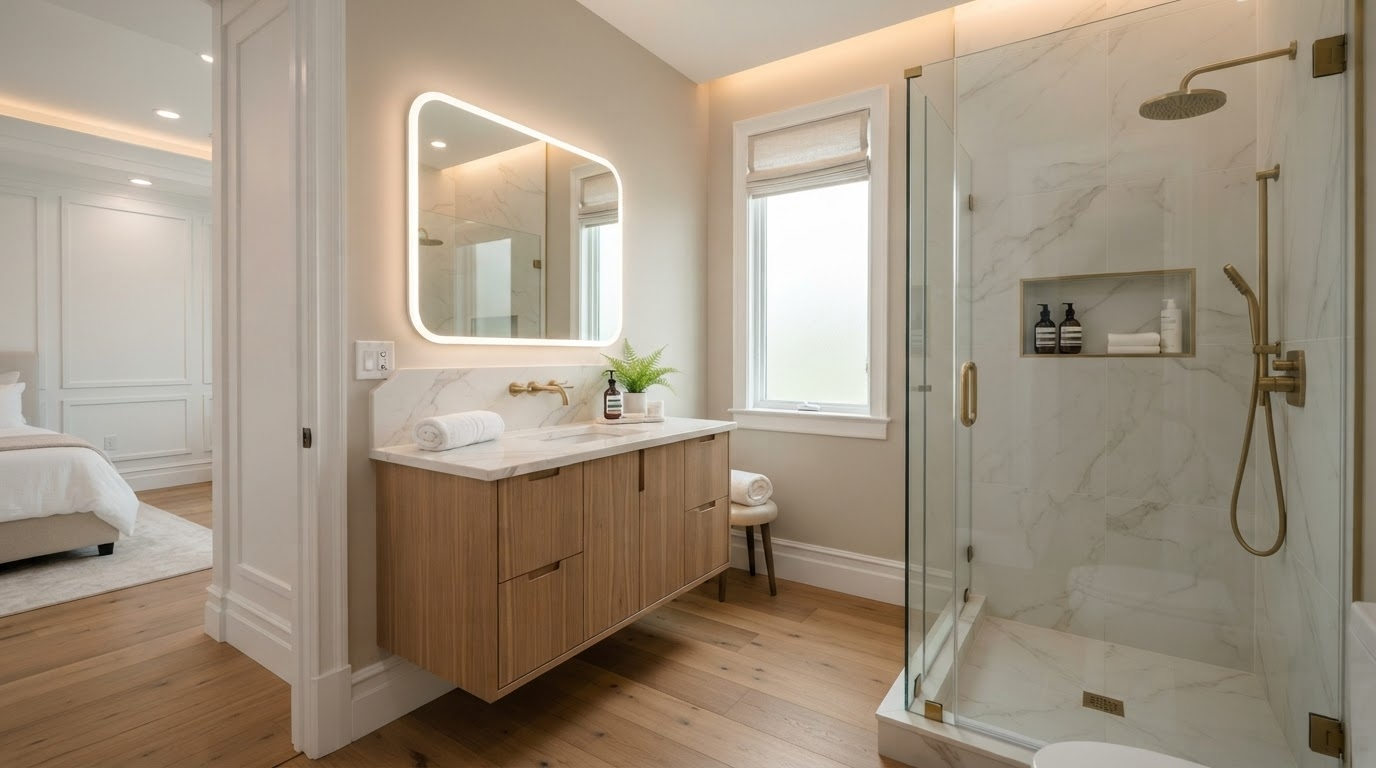
At the premium level, the difference is execution rather than scope. The shower gets large-format porcelain with tight, minimal grout lines, a tiled niche with a solid-surface shelf, and a frameless glass panel. The vanity is semi-custom or custom with soft-close everything and a full-height quartz backsplash. Fixtures move up to brands with real warranties and better finishes.
This tier is also where minor plumbing relocation usually enters the picture widening a shower into a former linen closet, or shifting a vanity drain to make room for a double sink in a compact primary bath.
Premium is the right choice for homeowners in South Tampa, Westchase, Davis Islands, and Hyde Park where surrounding home values support the finish level, and for anyone who intends to stay in the home long enough that daily quality matters more than resale math.
Luxury small bathroom remodel - $30,000 and up
A small bathroom can absolutely become a luxury space. Square footage limits how much you can fit, not how well it can be built.
Luxury small baths typically involve large-format porcelain slabs or natural stone, fully custom cabinetry built to the exact opening, designer plumbing fixtures, frameless glass with custom hardware, a statement tile wall, layered lighting with dimming and integrated mirror illumination, heated floors, curbless shower entry, and spa-inspired features like a linear drain, thermostatic valve, or steam capability.
Costs climb at this level for two reasons that have nothing to do with size: material tolerances tighten, so substrate prep and installation labor increase sharply, and lead times on custom cabinetry, stone slabs, and specialty fixtures extend the schedule.
Does a Small Bathroom Always Cost Less?
No - not proportionally. This is the single most common budgeting mistake in a small bathroom renovation in Tampa, and it catches first-time remodelers almost every time.
A large share of a bathroom remodel is fixed cost that does not care how many square feet the room has:
- Labor mobilization. The same trades show up regardless of size. A plumber charges for the trip and the day, not the square footage.
- Demolition. Removing a cast-iron tub from a 35-square-foot bathroom is harder than removing one from a 70-square-foot bathroom, because there is nowhere to stand.
- Plumbing. A small bath still has a toilet drain, a shower drain, a vanity drain, supply lines, and a shower valve. That is the same fixture count as a larger bath.
- Electrical. GFCI protection, lighting circuits, and exhaust fan wiring are required at any size.
- Waterproofing. A shower is a shower. The membrane, pan, corners, and seams have to be built correctly whether the enclosure is 30 by 60 inches or 48 by 72.
- Permitting and inspections. Fees and inspection visits are scope-driven, not size-driven.
- Fixtures. A toilet, vanity, faucet, valve, and showerhead cost what they cost.
What actually scales with size is tile quantity, flooring quantity, and some installation hours. That is a meaningful share of the budget, but it is not most of it. In practice, a 35-square-foot bathroom often costs 60 to 75 percent of what a 60-square-foot bathroom costs - not half.
There is a related effect worth knowing: small bathrooms carry a higher cost per square foot than large ones, because all of that fixed cost gets divided across fewer feet. That is why a powder room can quote at a startling per-square-foot number while still being the least expensive room in the house to remodel.
What Makes a Small Bathroom Remodel More Expensive?
If your estimate came back higher than expected, one or more of these is almost certainly why.
- Moving plumbing. Relocating a toilet, shower drain, or vanity drain means opening the floor, rerouting drain and supply lines, and re-inspecting. On a slab-on-grade Tampa home this can mean cutting and patching concrete. Expect roughly $1,000 to $5,000 per fixture relocated.
- Changing the layout. Layout changes cascade. Moving one fixture usually moves two others, and often triggers structural or framing work.
- Custom cabinetry. A custom vanity built to a non-standard opening can cost three to five times a comparable stock unit, and carries lead time.
- Premium tile. Natural stone and specialty porcelain can run $15 to $50 per square foot in material alone, before installation.
- Complex tile patterns. Herringbone, chevron, mosaic, and accent banding can double installation hours for the same tile. Pattern is a labor decision, not a material decision.
- Frameless shower glass. Frameless enclosures typically run $800 to $2,500 or more installed, and they require the tile behind them to be exceptionally flat and plumb which adds substrate prep.
- Electrical upgrades. Older Tampa homes frequently lack GFCI protection or adequate circuit capacity. Bringing a bathroom to current code can mean new circuits and, occasionally, panel work.
- Water damage. Failed shower pans and leaking valves are common in Florida bathrooms built before modern waterproofing standards. Damage is only visible after demolition.
- Subfloor repairs. Rotted or delaminated subfloor must be replaced before tile goes down. On a slab, the equivalent issue is moisture intrusion requiring mitigation.
- Waterproofing problems. Older showers often have no membrane at all, only mortar bed over building felt. Rebuilding correctly costs more than patching, and is the only defensible option.
- Structural changes. Widening a doorway for accessibility, borrowing space from a closet, or altering framing brings engineering and permitting into the project.
- Premium fixtures. Thermostatic valves, multi-function shower systems, wall-hung toilets with in-wall carriers, and designer faucets each add several hundred to several thousand dollars.
How to Save Money on a Small Bathroom Remodel
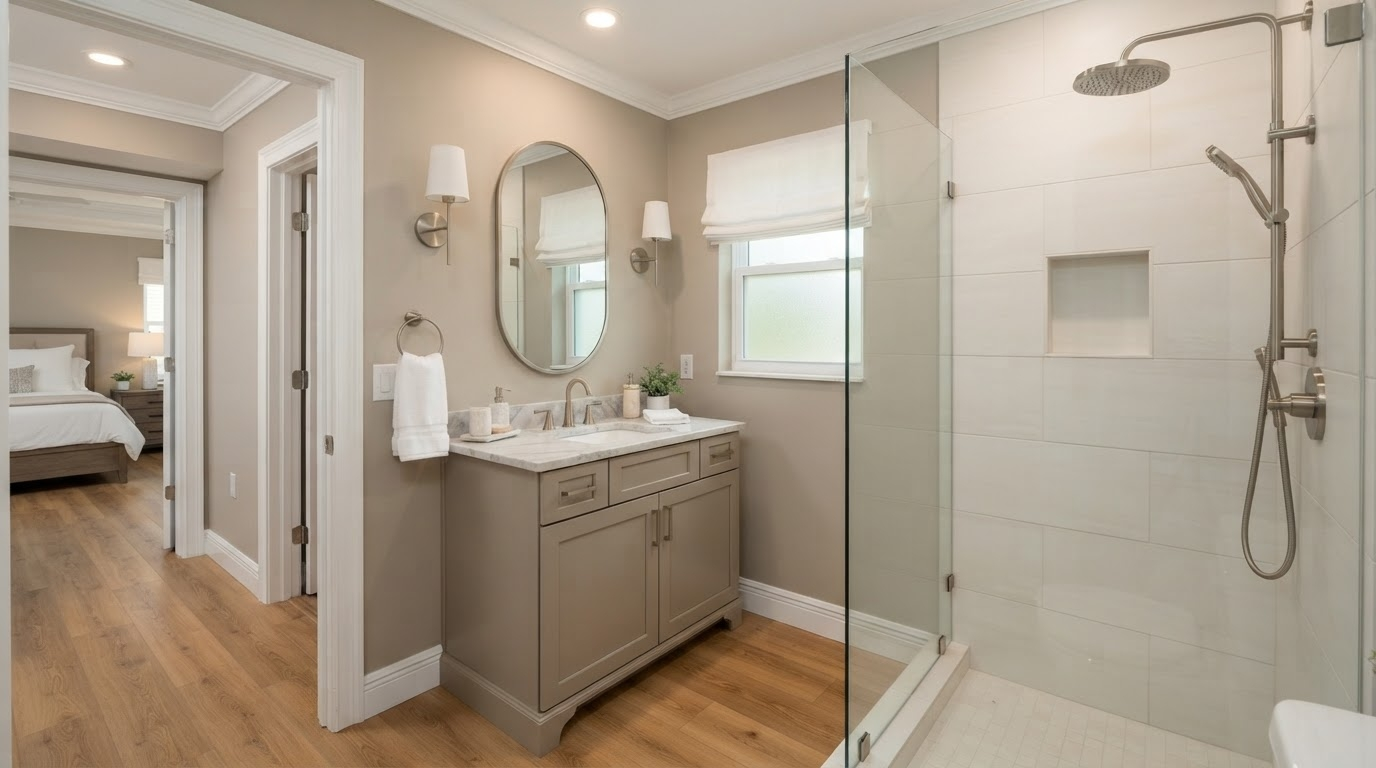
Every one of these reduces cost without reducing the quality of what is behind the wall. That distinction matters, and the list of things you should never cut follows immediately after.
- Keep the existing plumbing layout. This is the biggest lever available. Leaving the toilet, shower, and vanity where they are can save thousands and shorten the schedule.
- Reuse functional infrastructure. If supply lines, the drain stack, and the subfloor are sound, there is no reason to replace them. A good contractor tells you what is fine, not just what is replaceable.
- Choose standard-size vanities. A 30, 36, or 48-inch stock or semi-custom vanity in a quality finish looks excellent and costs a fraction of custom millwork.
- Use statement tile selectively. Run an affordable large-format porcelain across the floor and shower walls, then spend the saved money on one accent a niche, a single feature wall, or the floor of the shower.
- Compare material options before committing. Porcelain that convincingly imitates marble costs a fraction of marble and outperforms it in a humid bathroom. Ask to see both.
- Upgrade high-impact features first. Vanity, mirror, lighting, and shower glass drive the perception of the room more than anything else. Prioritize in that order.
- Improve the lighting. Replacing one dim overhead fixture with layered lighting is among the cheapest changes with the largest visual payoff.
- Use smart storage instead of more square footage. A recessed medicine cabinet, an in-wall niche, and a vanity with drawers rather than doors add usable storage without moving a wall.
- Avoid unnecessary structural changes. If the room works, do not rearrange it for the sake of rearranging it.
- Bundle projects. If a second bathroom or a flooring project is coming within the year, doing them together spreads mobilization and permitting across more work.
Never sacrifice waterproofing, plumbing quality, electrical safety, or proper installation to reduce the budget. In Florida's humidity, a shower built without a proper membrane will fail - not if, when - and the repair costs several times what doing it correctly would have. The same applies to skipping GFCI protection, undersizing the exhaust fan, or venting it into the attic instead of outdoors. These are the parts of the project nobody sees, which is exactly why they are the parts that get cut. Do not let them be.
Walk-In Shower vs. Bathtub: Cost Comparison
This is the most-asked question in a small bathroom remodel, and the honest answer depends on who is going to live in the house and for how long.
| Factor | Walk-in shower | Bathtub / tub-shower combo |
|---|---|---|
| Typical installed cost | Prefab conversion $1,000–$8,000; fully tiled walk-in $3,500–$15,000 | Bathtub installation $1,500–$8,000 including surround |
| Waterproofing | More demanding - pan, curb or curbless entry, full wall membrane | Simpler - tub flange handles most of the wall-to-basin transition |
| Tile | Higher quantity; full wall coverage is standard | Lower - typically three walls to shower height only |
| Glass | Framed door $300–$800; frameless panel or enclosure $800–$2,500+ | Often none, or a simple sliding door / curtain rod |
| Plumbing | May require drain relocation if replacing a tub footprint | Usually reuses the existing drain and valve location |
| Accessibility | Strong - low or zero threshold, bench and grab bar friendly | Weak - stepping over a tub wall is the most common in-home fall risk for older adults |
| Maintenance | More grout to clean; frameless glass needs regular squeegeeing | Less grout; acrylic surrounds wipe down quickly |
| Design impact | Opens the room visually, especially with clear glass | Visually breaks the room, but stores water for soaking |
| Resale consideration | Preferred in primary baths and in aging-in-place markets | NAHB survey data indicates roughly 74% of buyers want both a tub and a shower in the primary bath |
When a walk-in shower makes sense in a small Tampa bathroom
- You have another tub in the house. Removing the only bathtub in a family home can narrow your buyer pool later. If a second bath has a tub, converting is low-risk.
- Aging in place is a factor. For homeowners planning to stay in the house long-term, a curbless or low-threshold shower with a bench and properly blocked grab bars is one of the highest-value changes you can make - and it does not have to look clinical.
- The tub is never used. A garden tub that collects dust in a small primary bath is square footage doing nothing. Converting it usually makes the room feel dramatically larger.
- The existing tub is failing. If a cast-iron or fiberglass tub is cracked, stained, or leaking, the demolition is happening anyway. The incremental cost of converting is smaller than starting fresh later.
If the small bathroom in question is the only full bath in the house, or the home is likely to sell to families with young children, keeping a tub - even a compact one - is usually the wiser call.
Small Bathroom Remodeling Materials Compared
Material choice is where Tampa homeowners have the most control over budget - and where Florida's climate should influence the decision more than a design trend should.
| Material | Typical cost | Appearance | Maintenance & durability | Best application |
|---|---|---|---|---|
| Porcelain tile | $3–$20 / sq ft material | Enormous range, including convincing marble, concrete and wood-look finishes | Very low water absorption, hard-wearing, does not need sealing. The most forgiving choice in humidity. | Shower walls, shower floors, bathroom floors - the default recommendation for Tampa baths |
| Ceramic tile | $2–$10 / sq ft material | Wide selection; classic subway and field tile | Softer and more porous than porcelain but entirely adequate on walls. Less suited to floors in heavy-use baths. | Shower and wall surfaces on a budget; accent tile |
| Natural stone | $5–$30+ / sq ft material | Unmatched depth and variation; no two slabs alike | Porous. Requires sealing on a schedule and is vulnerable to etching from common bathroom products. Higher installation labor. | Feature walls, vanity tops, and luxury applications where the owner accepts the upkeep |
| Luxury vinyl (LVP / LVT) | $3–$8 / sq ft installed | Realistic wood and stone visuals; warm underfoot | Waterproof, resilient, forgiving of subfloor imperfection, easy to clean. Not suitable inside a wet shower. | Bathroom floors on a budget, and for continuity with adjacent living-area flooring |
| Quartz (engineered) | $50–$150 / sq ft installed | Consistent color and pattern; marble-look options are excellent | Non-porous, never needs sealing, highly stain-resistant. The lowest-maintenance premium surface. | Vanity tops, shower benches and shelves, full-height backsplashes |
| Solid surface | $40–$100 / sq ft installed | Seamless, uniform, integrated sink options | Repairable - scratches sand out. Softer than quartz and less heat-tolerant, which matters little in a bathroom. | Integrated vanity tops, shower pans, and accessible or curbless applications |
| Cultured marble | $25–$60 / sq ft installed | Uniform, slightly glossy; limited pattern range | Non-porous and inexpensive. Surface can dull over time and is harder to repair than solid surface. | Budget vanity tops and one-piece shower surrounds |
A note on Florida humidity
Tampa Bay averages high relative humidity year-round, and a bathroom adds moisture on top of that. Materials with low water absorption - porcelain, quartz, solid surface - hold up better here than porous ones. That is not a marketing claim; it is why porcelain dominates specification in Florida bathrooms.
The larger point is that no material survives a badly built assembly. Porcelain over a shower with no waterproofing membrane still fails. Material selection is the visible half of the decision; the substrate and membrane behind it are the half that determines whether the bathroom lasts fifteen years or five.
How Long Does a Small Bathroom Remodel Take?
A small bathroom remodel in Tampa typically takes two to six weeks of on-site work. A cosmetic refresh can finish in one to two weeks. A premium or luxury build with custom tile, custom cabinetry, and fabricated glass runs longer.
The number that surprises people is the planning phase. Material selection and ordering happen before demolition, and lead times on vanities, tile, and especially frameless glass and custom stone can exceed the construction schedule itself.
Typical project sequence
| # | Phase | Typical duration | What happens |
|---|---|---|---|
| 1 | Planning & design | 1–3 weeks | Site assessment, measurements, scope definition, written estimate, contract |
| 2 | Material selection & ordering | 1–4 weeks | Tile, vanity, top, fixtures, glass. Lead times drive this, not labor. |
| 3 | Permitting | 3 days – 3 weeks | Application and plan review, where required by scope. Varies by jurisdiction and workload. |
| 4 | Demolition | 1–2 days | Tear-out, disposal, and the first honest look at what is behind the walls |
| 5 | Rough plumbing & electrical | 2–4 days | Drain and supply work, valve set, circuits, fan duct, blocking for grab bars |
| 6 | Rough inspection | 1–3 days | Inspector signs off before anything gets covered. Cannot be skipped or rushed. |
| 7 | Waterproofing & substrate | 2–4 days | Backer board, membrane, pan assembly, corner and seam detailing, cure time |
| 8 | Tile installation | 3–7 days | Floor and walls, then grout. Complex patterns and large-format add days. |
| 9 | Vanity & fixtures | 1–3 days | Cabinet set, top, sink, faucet, toilet, trim, mirror, lighting |
| 10 | Glass measure & install | 1–3 weeks after tile | Glass is measured only after tile is set, then fabricated. This is the most common late-stage delay. |
| 11 | Final inspection | 1–3 days | Trade finals and permit close-out where applicable |
| 12 | Punch list & walkthrough | 1–3 days | Touch-ups, adjustments, and final sign-off before the project is considered complete |
Timelines vary with scope, material lead times, inspection scheduling, and conditions discovered after demolition. No reputable contractor guarantees a completion date before demolition reveals what is actually behind the walls.
Tampa Permit Considerations for a Bathroom Remodel
Whether you need a permit depends on the scope of work, not on the word "remodel." That is the honest answer, and any contractor who gives you a blanket yes or no without asking what the project involves is guessing.
Work that generally requires a permit
- Plumbing - relocating or replacing drain and supply lines, moving fixtures, replacing a water heater
- Electrical - new circuits, added lighting locations, panel work, adding or relocating an exhaust fan
- Mechanical - new or rerouted exhaust ducting
- Structural - altering framing, widening a doorway, removing or modifying a wall
Work that generally does not
- Painting, wallpaper, and decorative finishes
- Swapping a vanity, mirror, or light fixture in the same location with no wiring or plumbing changes
- Replacing a toilet in place
- Installing accessories, hardware, and shelving
Which office issues your permit
Hillsborough County contains multiple permitting jurisdictions, and your address determines which one applies. Homes inside Tampa city limits go through the City of Tampa's Construction Services Division, which handles residential permits through its online portal. Homes in unincorporated Hillsborough County go through Hillsborough County Building Services. Temple Terrace and Plant City each administer their own. Pinellas County addresses - St. Petersburg, Clearwater, Largo - go through their respective municipal offices.
Permit costs for a small bathroom remodel in Tampa generally fall in the $300 to $600 range depending on how many trade permits the scope requires and applicable state surcharges. Fee schedules change; confirm current figures with the issuing jurisdiction or let your contractor handle it.
Condo and HOA considerations
Condo bathroom remodels in Tampa carry a second layer of approval on top of the municipal one. Most associations require submitted plans, proof of contractor licensure and insurance, and adherence to work-hour restrictions and elevator-use scheduling. Buildings frequently require soundproofing underlayment and impose rules about shutting off water risers. Start the association approval process early - it is often slower than the permit.
Why permits are worth pulling
Remodels by Renov8 Plus is a licensed Florida general contractor (CGC #1537706). We pull the permits, schedule the inspections, and close them out as part of the project.
Hidden Costs Tampa Homeowners Should Prepare For
Nobody can price what is behind a wall before opening it. What a good contractor can do is tell you honestly what is likely, given the age and construction of your home, and make sure your budget has room for it.
| Hidden cost | How common in Tampa | Typical impact |
|---|---|---|
| Water damage behind the shower | Very common in homes built before modern waterproofing standards | Framing repair, subfloor or wall replacement; often $500–$3,000 |
| Mold remediation | Common where a shower has leaked for years in a humid climate | Professional remediation varies widely with extent; not a DIY item |
| Old or failing plumbing | Common in homes with galvanized, polybutylene, or original cast-iron drains | Partial repiping within the bathroom; $800–$4,000+ |
| Subfloor damage | Common in raised-floor construction; on slab, the parallel issue is moisture intrusion | Sheathing replacement and leveling; $400–$2,000 |
| Outdated electrical | Very common - many older baths lack GFCI protection entirely | New circuits and GFCI protection; $400–$2,000 |
| Structural surprises | Occasional - notched joists, undersized headers, prior unpermitted work | Varies; may require engineering |
| Material delays or backorders | Occasional, especially on custom vanities, stone slabs, and glass | Schedule impact rather than direct cost |
| Code-required upgrades | Likely any time a permit is pulled on an older home | Ventilation, GFCI, valve type, and clearance corrections |
Budget a contingency
Set aside 10 to 20 percent of your project budget as a contingency. On a $16,000 mid-range remodel, that is $1,600 to $3,200 held in reserve. If nothing goes wrong, you keep it. If something does, the project does not stop while you find the money - and you are not forced to downgrade finishes to cover a plumbing repair.
This is standard practice in the industry and the single best protection against the "surprise cost" horror stories homeowners read online.
Small Bathroom Design Ideas That Stretch the Budget
These are the choices that make a small bathroom read as larger and more expensive than it was without adding square footage or moving plumbing.
- Large-format tile. Fewer grout lines means fewer visual interruptions, and the eye reads the surface as continuous. A 12x24 or larger tile makes a small floor look bigger than a 4-inch mosaic does.
- A floating vanity. Seeing the floor run underneath the cabinet is a genuine spatial trick the room reads as having more floor than it does. It also makes cleaning easier.
- Light-colored surfaces. Pale walls, floors, and tile bounce light instead of absorbing it. Save the drama for a single accent rather than the whole room.
- Frameless glass. Replacing a curtain or a framed door with clear frameless glass removes the visual wall that cuts a small bathroom in half. This is the highest-impact single upgrade in most small baths.
- Recessed storage. A niche in the shower and a recessed medicine cabinet add real storage inside the wall cavity instead of projecting into the room.
- One oversized mirror. A large mirror - ideally wall-to-wall above the vanity - doubles the perceived depth of the room. It costs a fraction of what the effect suggests.
- Layered lighting. Replace one dim ceiling fixture with a combination of overhead, vanity-level, and accent lighting. Poor lighting makes every other finish look cheaper than it is.
- One statement wall. Concentrate the interesting tile on a single surface - the shower back wall or the wall behind the vanity - and keep everything else simple. Costs less, looks more intentional.
- Wall-mounted fixtures. Wall-mounted faucets and a wall-hung toilet free up counter and floor space and give the room a cleaner line. Note that wall-hung toilets require in-wall carriers and are a plumbing decision, not a finish decision.
- Continuous flooring. Running the same flooring from the hallway into the bathroom removes a visual break at the threshold and makes both spaces feel larger.
Common Bathroom Remodeling Mistakes
- Hiring on price alone. The cheapest of three quotes is cheaper for a reason. Find the reason before you decide. Sometimes it is efficiency; more often it is a thinner scope, cheaper materials, or work that will not be permitted.
- Moving plumbing without a real reason. Relocation is the most expensive decision available in a small bathroom. If the current layout functions, the money is better spent on finishes.
- Choosing materials without considering maintenance. Natural stone is beautiful and requires sealing. Matte black fixtures show water spots. Dark grout hides dirt; light grout does not. Know what you are signing up for.
- Ignoring ventilation. Florida Building Code sets a minimum of 50 CFM of intermittent exhaust for a bathroom, and requires that it discharge outdoors rather than into an attic. That minimum is a floor, not a target - the Home Ventilating Institute recommends roughly 1 CFM per square foot for bathrooms up to 100 square feet. An undersized or improperly ducted fan is how mold problems start in this climate.
- Cutting waterproofing. The most expensive mistake on this list. A shower without a proper membrane assembly will leak, and the repair means demolishing the finished bathroom you just paid for.
- Underestimating labor. Labor is commonly 40 to 50 percent of a bathroom budget. Homeowners who price only materials are routinely shocked by the estimate.
- Forgetting storage. It is easy to design a beautiful bathroom with nowhere to put anything. Plan storage before finishes.
- Poor lighting. One builder-grade fixture over the mirror will undercut a $20,000 remodel.
- No contingency budget. Covered above - this is the difference between an inconvenience and a stalled project.
- No detailed written scope. A one-line estimate is not a scope. You want line items, allowances, a payment schedule, and a written change-order process. If a contractor resists putting the scope in writing, that is the answer to your question about that contractor.
Tampa Bathroom Remodel Prices: Cost Comparison Table
| Remodel type | Approx. investment | Best for | Typical scope |
|---|---|---|---|
| Budget | $4,000 – $9,000 | Half-baths, guest baths, pre-sale updates, rentals | Same layout. New vanity, toilet, mirror, lighting, fixtures, paint, and either new LVP flooring or a tub reglaze. Minimal or no tile work. Often no permit required. |
| Mid-range | $12,000 – $20,000 | Most Tampa homeowners; primary and guest baths in homes being kept 5+ years | Full tear-out. New tiled shower with proper waterproofing, new floor tile, semi-custom vanity, quartz or cultured marble top, new fixtures, lighting, and correctly sized exhaust fan. Layout unchanged. |
| Premium | $20,000 – $30,000 | South Tampa, Westchase, Hyde Park, Davis Islands and comparable neighborhoods | Large-format or patterned tile, custom or semi-custom cabinetry, quartz throughout, frameless glass, upgraded fixtures, niche and bench detailing, often minor plumbing relocation. |
| Luxury | $30,000+ | Waterfront and luxury-segment homes; long-term owners wanting a spa-grade result | Custom cabinetry, designer fixtures, natural stone or porcelain slab, curbless entry, heated floors, integrated and layered lighting, statement tile, and layout changes that relocate plumbing. |
Every figure in this guide is a planning estimate, not a guaranteed contractor quote. Actual pricing depends on your bathroom's dimensions, its existing condition, the specific materials selected, the plumbing and electrical work required, permitting, and current material and labor pricing at the time of the project. A written estimate from a licensed contractor following an in-home assessment is the only figure you should budget against.
Is a Small Bathroom Remodel Worth It?
For most Tampa homeowners, yes with the caveat that the return depends heavily on which tier you build.
National data from the 2025 Cost vs. Value Report put midrange bathroom remodels at roughly 80 percent of cost recouped at resale, up substantially from about 73 percent the prior year, while upscale remodels recouped closer to 45 percent and universal-design (accessibility-focused) baths came in around 61 percent. The pattern is consistent year over year: mid-range work returns the most, because its finishes appeal to the widest pool of buyers.
That said, resale is only one reason to remodel, and for most people it is not the main one. A bathroom that no longer leaks, ventilates properly, has safe wiring, and is genuinely pleasant to use every morning delivers a return that does not appear in any report. Resale percentages are a useful sanity check on how much to spend not a reason to spend it.
Planning a Small Bathroom Remodel in Tampa?
Every number in this guide is a planning estimate. The number that matters is the one that comes after somebody stands in your bathroom, looks at your plumbing, and tells you honestly what your project involves.
That is what we do. Remodels by Renov8 Plus has spent more than a decade remodeling bathrooms across Tampa Bay South Tampa, Carrollwood, Westchase, New Tampa, Brandon, Riverview, Wesley Chapel, Clearwater, and St. Petersburg. As a licensed Florida design-build contractor, we handle design, material selection, permitting, construction, and inspections under one roof, with one dedicated project manager you can actually reach.
On a free in-home consultation, we will walk your bathroom with you, talk through what you want and what your budget realistically supports, recommend materials suited to Florida humidity, define a clear written scope, and give you a personalized estimate. No pressure, no obligation, and no vague "it depends" pricing.
Tell us about your bathroom and we will give you a clear, written, no-obligation estimate - with a real scope, real material recommendations, and a realistic timeline. Licensed, insured, and local to Tampa Bay for over a decade.
GET YOUR FREE ESTIMATE
Call or text (656) 232-0999 · info@renov8plus.com · renov8plus.com