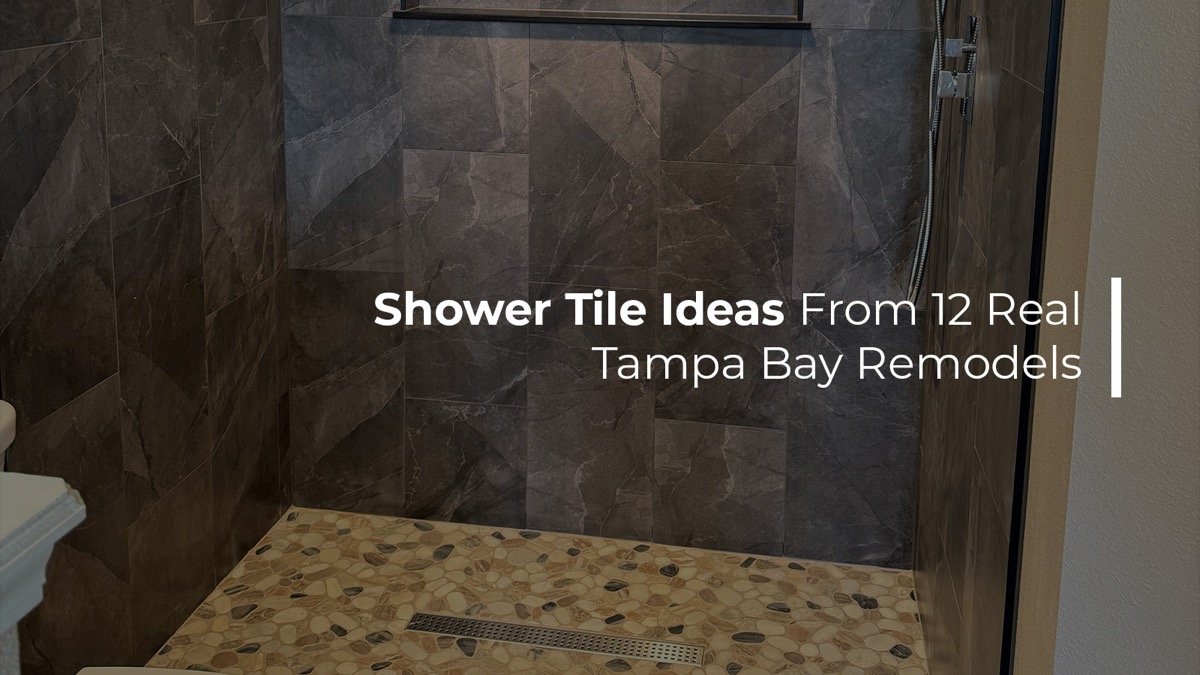
The shower used to be the part of the bathroom nobody looked at. Now it is usually the first thing people notice. Frameless glass took away the shower curtain, and what is behind it became a design feature instead of a hidden corner.
That is why shower tile ideas have become one of the most searched parts of a bathroom project. Homeowners have more choices than ever porcelain that convincingly imitates marble, handmade-look tile, textured panels, formats that run four feet wide. The options are genuinely exciting. They are also easy to get wrong.
In Tampa Bay, that risk is higher than it is in most of the country. Our humidity does not take a season off. Bathrooms here run wet longer, dry slower, and see more sunlight through more windows than bathrooms in cooler climates. A tile that photographs beautifully in a Pacific Northwest showroom may need more upkeep than you expected once it is installed in Carrollwood or Clearwater.
So this guide does both jobs. Below are 12 shower tile designs drawn from real bathroom remodeling work across Tampa Bay: what each one looks like, what it is made of, who it suits, and honestly, where each one gives you trouble. Every section is written so you can show it to your designer or contractor and say: this is the look I want.
What Are the Best Shower Tile Ideas for Tampa Homes?
Key Takeaways
- Large-format tile makes a shower look bigger. Fewer grout lines means fewer visual interruptions, and less grout to scrub.
- Mosaic belongs on the floor, not usually the walls. The extra grout joints that make walls harder to clean are exactly what give a shower floor its footing.
- Warm neutrals age better than cool grays. Beige, cream, greige and sand tones read as calm rather than clinical, and they date more slowly.
- Porcelain is the workhorse for Florida bathrooms. It handles constant moisture with minimal maintenance and requires no sealing.
- Curbless showers need planning, not just tile. Slope, drainage, and waterproofing all have to be designed before demolition starts.
- The waterproofing behind the tile matters more than the tile. Tile and grout are not a waterproofing system. What sits behind them is what keeps water out of your walls.
- Put trends in the accents. Keep the large surfaces timeless and let a niche or a single wall carry whatever is fashionable this year.
12 Shower Tile Ideas From Tampa Bay Remodels
1. Large-Format Marble-Look Porcelain
This is the look most homeowners are picturing when they say they want a "high-end" shower. Panels in 24x48-inch or larger formats run floor to ceiling with soft gray or warm beige veining, and because each panel covers so much wall, you end up with only a handful of grout lines in the entire shower. The effect reads as one continuous slab of stone rather than a wall of tiles.
The practical argument is stronger than the aesthetic one. Real marble in a Tampa shower is a commitment it is porous, it needs periodic sealing, and it can etch when it meets everyday shower products. Marble-look porcelain gives you the appearance with essentially none of that maintenance.
- Tile type: Porcelain, rectified edges for the tightest possible grout joints
- Palette: Warm white, soft gray veining, cream, greige
- Size: 24x48 inches and up
- Pattern: Stacked, or book-matched across a feature wall
- Best for: Modern and transitional master bathrooms; luxury renovations
- Advantages: Minimal grout, easy cleaning, no sealing, strong visual impact
- Drawbacks: Higher material cost; large panels are heavy and demand a very flat substrate
- Tampa fit: Excellent. Low absorption and few grout lines suit high-humidity bathrooms well.
Choose this if you want a spa feel with the least ongoing upkeep, and your walls can be prepped flat enough to take large panels. That prep is not optional big tile is unforgiving of a wavy wall.
2. Vertical Stacked Shower Tile
Most tile gets installed horizontally out of habit. Turning it vertical is one of the cheapest design moves available, and in a standard eight-foot bathroom it makes a real difference. Stacked vertical tile draws the eye upward, and the shower reads taller than it measures.
This is a favorite in Tampa condos and townhomes, where ceiling height is fixed and the bathroom footprint is not going to grow. Elongated shapes work best a 4x12 or 3x12 tile stacked in clean columns. Straight stacking gives a crisp modern grid; a vertical offset softens it slightly.
- Tile type: Ceramic or porcelain in elongated rectangles
- Palette: Warm white, sand, soft gray, muted green
- Size: 3x12, 4x12, 4x16 inches
- Pattern: Straight vertical stack, or vertical offset
- Best for: Standard-height showers, condos, guest baths, modern styling
- Advantages: Adds perceived height at no extra material cost; widely available
- Drawbacks: A straight stack exposes every alignment error installer skill shows here
- Tampa fit: Very good, particularly in coastal condos with lower ceilings
Use a grout color close to the tile. High-contrast grout on a vertical stack turns the wall into a graph-paper grid, which is a much busier look than most people intend.
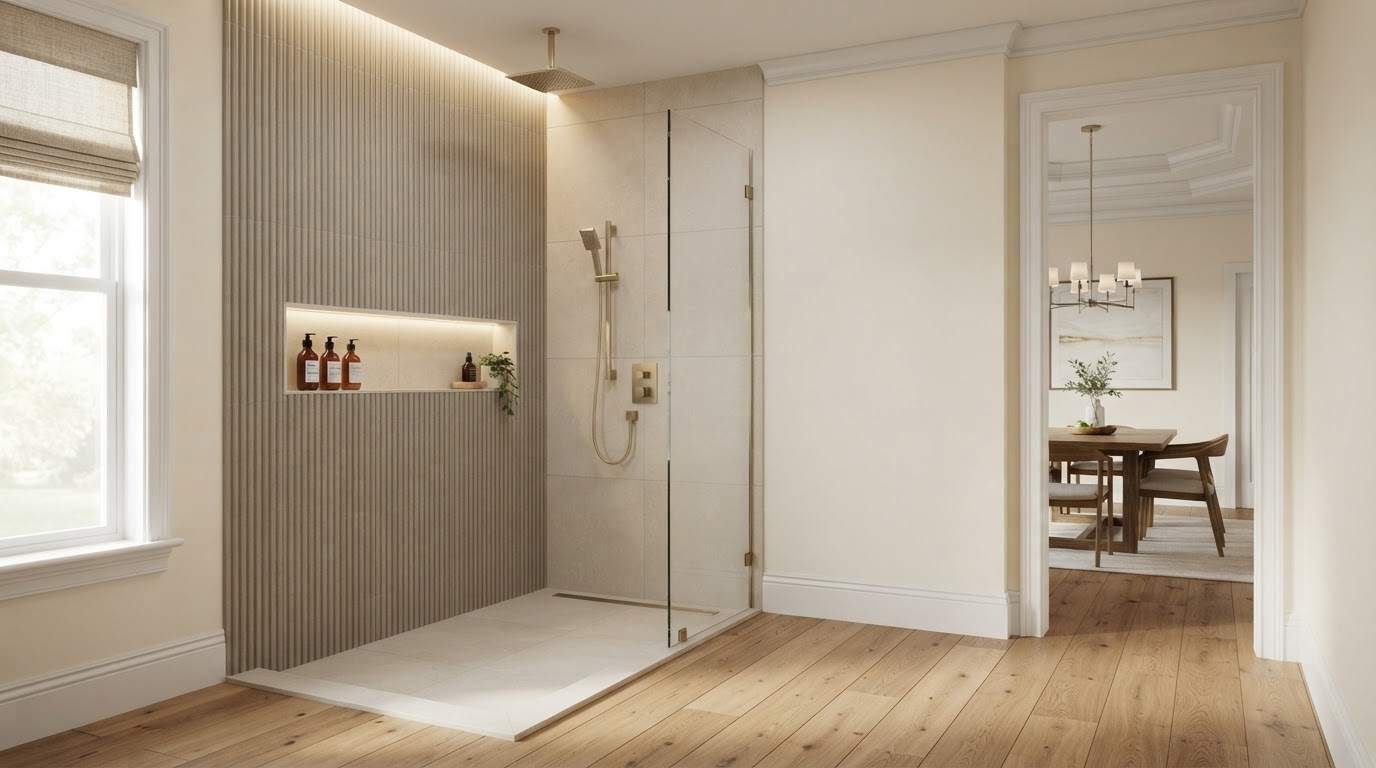
3. Warm Beige and Limestone-Look Tile
Cool gray dominated bathrooms for most of the last decade, and a lot of those bathrooms now feel cold. Warm neutrals have taken over for a reason: beige, cream, sand and warm white make a bathroom feel restful instead of sterile, and they hold up far better against changing taste.
Limestone-look porcelain is the strongest version of this idea. It carries the soft, chalky, slightly textured look of real limestone without the porosity that makes actual limestone a questionable choice for a wet Florida shower. Paired with warm brass or matte black fixtures and natural wood, it lands somewhere close to a resort bathroom.
- Tile type: Porcelain with a limestone or travertine visual
- Palette: Beige, cream, sand, warm white, light taupe
- Size: 12x24 through 24x48 inches
- Pattern: Stacked or one-third offset
- Best for: Spa-style bathrooms; homeowners planning to stay long-term
- Advantages: Calming, forgiving of water spots, coordinates with almost any fixture finish
- Drawbacks: Reads as safe if the whole bathroom stays in one tone - needs some texture contrast
- Tampa fit: Excellent. Warm neutrals suit Florida light and hide hard-water spotting well.
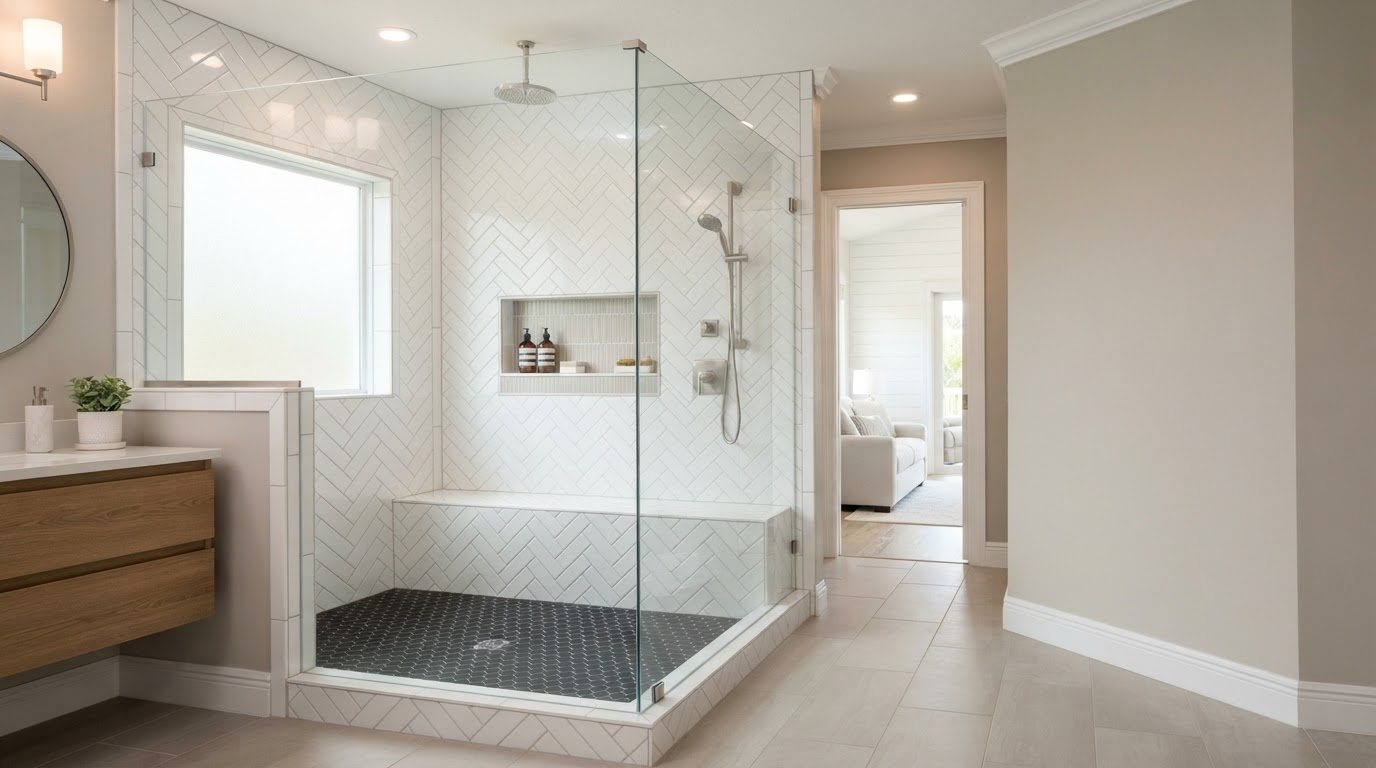
4. Herringbone Shower Tile
Herringbone takes ordinary rectangular tile and turns it into a pattern with real movement. The interlocking V shape works on a full shower wall, on a single accent wall, or on the shower floor and it is one of the few patterns that looks intentional at almost any scale.
Be honest with yourself about the labor. Herringbone requires far more cutting than a stacked layout, waste runs higher, and it takes an experienced installer to keep the pattern true across a full wall. That shows up in the quote. It is worth it on one focal wall; it can be overwhelming, and expensive, on all four.
- Tile type: Porcelain, ceramic, or marble-look small format
- Palette: Warm white, greige, soft green, marble-look
- Size: 2x8, 3x9, 3x12 inches
- Pattern: Classic 45-degree herringbone, or a vertical variation
- Best for: Accent walls, niches, transitional and classic bathrooms
- Advantages: Adds texture and interest without introducing another color
- Drawbacks: Higher labor cost, more waste, more grout to maintain
- Tampa fit: Good - best used as an accent rather than every surface
Keep everything else quiet. If the shower has a herringbone wall, the floor, the vanity and the fixtures should all stay simple. One pattern gets to be the star.
5. Hexagon Mosaic Shower Tile
Hexagons are the most useful shape in a shower, and most of that usefulness is underfoot. Small hexagon mosaic on a shower floor gives you a dense network of grout joints, and those joints are what your feet actually grip. Because the sheets flex, they also conform to the slope toward the drain far more easily than large tile can.
Above the floor, hexagons work as a graphic accent a niche back, a band, a single wall. Large-format hexagons in a marble-look finish feel contemporary and architectural. Small white hexagons with dark grout are a classic Florida bungalow look that suits older homes in Seminole Heights and Hyde Park.
- Tile type: Porcelain or ceramic mosaic, mesh-mounted
- Palette: White, charcoal, marble-look, warm gray
- Size: 1–2 inch mosaic for floors; 4 inch and up for wall accents
- Pattern: Standard honeycomb
- Best for: Shower floors, niches, accent bands
- Advantages: Conforms to slope, adds traction underfoot, visually distinctive
- Drawbacks: Significantly more grout to clean; can look busy across a large wall
- Tampa fit: Excellent for floors. Use a quality grout and keep the bathroom well ventilated.
6. Curbless Walk-In Shower
A curbless shower removes the step entirely. The bathroom floor runs straight into the shower with no lip to cross, and the whole room reads as one continuous space. It is the single most requested walk-in shower configuration we see in Tampa Bay, and the reasons are split between design and practicality.
On the design side, continuous flooring makes a small bathroom look considerably larger, because the eye is not stopped by a threshold. On the practical side, a zero-threshold entry is far easier to use safely as you get older which matters a great deal to homeowners planning to stay in their homes in South Tampa and Palma Ceia rather than move later.
Here is the part that gets skipped: a curbless shower is a construction decision before it is a tile decision. Without a curb, the floor slope and the drain placement are doing all the work of containing water. That means the slope has to be right, the waterproofing has to extend well beyond the shower area, and often the subfloor needs to be recessed. This is not a change you can make late in a project, and it is not a good candidate for a low bid.
- Tile type: Large-format porcelain walls with mosaic or small-format floor
- Palette: Any continuity matters more than color here
- Pattern: Continuous floor tile running from the bathroom into the shower
- Best for: Aging in place, small bathrooms, modern master suites
- Advantages: Easier and safer entry, visually expands the room, easy to clean
- Drawbacks: More complex build; requires careful slope, drainage and waterproofing planning
- Tampa fit: Very good when built correctly. Linear drains simplify the slope in most layouts.
If a contractor quotes a curbless shower without discussing slope, drain type, and how far the waterproofing will extend past the shower opening, keep interviewing. Those three answers are the difference between a curbless shower that works for twenty years and one that quietly wets a wall.
7. Textured Shower Wall Tile
Texture is how you get a shower to feel custom without adding a single color. Fluted and ribbed tile, handmade-look surfaces, subtle 3D geometry all work by catching light and casting small shadows, so the wall changes character throughout the day.
That last point matters more in Florida than almost anywhere. Our light is strong and it moves. A fluted wall lit from the side by a bathroom window looks dramatic at nine in the morning and soft by late afternoon. If your bathroom has good natural light, textured tile gives you a surface that never looks quite the same twice. If your bathroom has one dim overhead fixture, most of that effect disappears plan the lighting alongside the tile, not after it.
- Tile type: Porcelain or ceramic with fluted, ribbed, or dimensional relief
- Palette: Warm white, cream, sage, soft gray, muted clay
- Size: Typically 4x12 to 12x24 inches
- Pattern: Vertical stack, which reinforces the ribbing
- Best for: Feature walls, niches, modern and organic-modern bathrooms
- Advantages: Distinctive, adds depth, works in a single neutral color
- Drawbacks: Grooves collect soap residue and need more attentive cleaning
- Tampa fit: Good with strong ventilation. Best on a feature wall rather than the full enclosure.
8. Wood-Look Porcelain
Real wood does not belong on a shower surface. In a Tampa bathroom it is a maintenance problem waiting to happen constant moisture, slow drying, and a material that moves with humidity. Wood-look porcelain solves the problem by borrowing the appearance and none of the behavior.
The warmth it adds is hard to get any other way. Stone and porcelain can leave a bathroom feeling a little cool and hard; a plank-format wood-look tile on one wall or as the shower floor introduces grain, variation, and something organic. Pairing it with a stone-look tile on the remaining walls is the combination that reads as intentional rather than accidental.
- Tile type: Porcelain plank with a wood-grain visual
- Palette: Warm oak, weathered gray, natural walnut, pale ash
- Size: 6x36, 8x48 inches and similar plank formats
- Pattern: Staggered offset, or vertical for a contemporary take
- Best for: Organic modern, Scandinavian and spa-inspired bathrooms
- Advantages: Warmth and grain with the durability of porcelain
- Drawbacks: Quality varies widely cheaper versions repeat the same grain pattern visibly
- Tampa fit: Excellent. Delivers the wood look with none of the moisture risk.
Look at a full box before you commit, not a single sample. Good wood-look tile uses many different plank faces; cheap tile uses three or four, and once you notice the repeat you cannot stop noticing it.
9. Coastal Blue Accent Tile
Living near the water tempts people toward nautical decor, and nautical decor dates fast. There is a more restrained version of coastal that works beautifully in Tampa Bay bathrooms and does not involve a single anchor or rope motif.
The trick is muting the color. Soft blue, sea-glass green, and gray-leaning aqua, kept as an accent against warm white and sand, suggest the water without announcing it. A niche back in muted aqua, or a single accent wall in sea glass behind an otherwise neutral shower, gives you the coastal feel in a form you can live with for a decade. Homeowners in Clearwater, St. Petersburg and Davis Islands gravitate toward this, and it suits the light here.
- Tile type: Glazed ceramic, porcelain, or glass mosaic for niches
- Palette: Muted blue, sea-glass green, soft aqua against sand and warm white
- Size: 2x6 through 4x12 inches; mosaic for small accents
- Pattern: Stacked, offset, or vertical
- Best for: Coastal and transitional bathrooms; guest baths
- Advantages: Adds personality in a contained, reversible way
- Drawbacks: Saturated blues date quickly - muted tones age much better
- Tampa fit: Very good as an accent. Avoid using a strong blue across every wall.
10. Zellige-Inspired Tile
Zellige-style tile is made to look handmade. Edges are slightly irregular, the surface undulates, and the glaze pools and shifts so no two pieces are quite the same color. Installed across a wall, it produces a shimmering, textured surface with real depth - the opposite of a machine-perfect grid.
The variation is the point, and it is also the thing homeowners sometimes regret. If you want uniformity, this is the wrong tile. Traditional zellige is also a more demanding installation, and true handmade versions vary in thickness. Zellige-inspired porcelain gives you most of the character with more predictable behavior in a wet area, which is usually the better trade in a Florida shower.
- Tile type: Zellige-inspired ceramic or porcelain (glazed, wet-area rated)
- Palette: Warm white, cream, sage, muted blue, soft clay
- Size: 2x6, 4x4, 2x8 inches
- Pattern: Offset, stacked, or vertical stack
- Best for: Character homes, organic modern, Mediterranean-influenced bathrooms
- Advantages: Genuine visual depth and warmth; feels crafted rather than mass-produced
- Drawbacks: Irregular surfaces need careful cleaning; not for anyone wanting uniformity
- Tampa fit: Good in the porcelain interpretation. Confirm wet-area suitability with the manufacturer.
Keep it to one color family and let the tile itself provide the variation. Zellige plus a bold pattern elsewhere is one idea too many.
11. Floor-to-Ceiling Shower Tile
Stopping tile at the standard height leaves a painted band above it, and that band is the single clearest signal that a shower was built to a budget. Running tile all the way to the ceiling costs more, and it changes the room more than almost any other decision on this list.
The eye follows the tile up and reads the ceiling as higher. There is no transition line to break the wall. And practically, the wall area above a shower is the part most exposed to steam, so tiling it removes the surface most likely to need repainting. In larger master bathrooms the kind common in Westchase, Lutz and newer Wesley Chapel construction floor-to-ceiling large-format porcelain is the detail that most reliably separates a renovated bathroom from a builder-grade one.
- Tile type: Large-format porcelain, ideally rectified
- Palette: Warm white, marble-look, greige, limestone-look
- Size: 12x24 through 24x48 inches
- Pattern: Stacked for a modern look; offset for something more traditional
- Best for: Master bathrooms, luxury renovations, tall enclosures
- Advantages: Adds height, removes a paint line, protects the steam-exposed upper wall
- Drawbacks: More material and labor; the added cost is real
- Tampa fit: Excellent. Removing painted surfaces from a humid bathroom is a durability win.
12. Contrasting Shower Floor and Wall Tile
You do not need a second color to make a shower interesting - you need a second value. Deliberately contrasting the floor against the walls gives the shower definition, grounds the space, and hides everyday wear far better than a single tone used everywhere.
Three combinations that consistently work:
- Warm white large-format walls with a charcoal hexagon floor. High contrast, crisp, and forgiving of water spots. The most versatile option on this list.
- Greige limestone-look walls with a warm marble-look mosaic floor. Softer and more layered a spa look rather than a graphic one.
- Vertical stacked cream walls with a wood-look plank floor. Organic and warm, and the plank format handles the slope well in a linear-drain layout.
One rule holds across all three: pick which surface is the quiet one before you shop. If the floor has a pattern, the walls should be plain. Two patterns fight, and the shower ends up feeling smaller than it is.
Shower Tile Comparison
A quick reference across the main tile categories. Maintenance ratings reflect typical ongoing effort, not installation difficulty.
| Tile Style | Best For | Maintenance | Design Impact | Tampa Suitability |
|---|---|---|---|---|
| Large-format porcelain | Walls, full enclosures | Low | Clean, spacious, modern | Excellent |
| Marble-look porcelain | Feature walls, master baths | Low | Luxury, high impact | Excellent |
| Ceramic | Walls, budget-conscious projects | Low to moderate | Classic, versatile | Good for walls |
| Mosaic | Shower floors, niches, accents | Higher (more grout) | Textural, detailed | Excellent on floors |
| Natural stone | Statement surfaces | High (sealing required) | Authentic, premium | Use with caution |
| Wood-look porcelain | Accent walls, floors | Low | Warm, organic | Excellent |
| Textured / fluted tile | Feature walls | Moderate | Dimensional, custom | Good with ventilation |
Always confirm a specific product's wet-area suitability against the manufacturer's technical data sheet. Categories generalize; individual products vary.
Best Shower Tile Materials for Tampa Homes
Porcelain
Porcelain is fired denser than ceramic, which leaves it with very low water absorption. In practice that means it handles constant moisture without absorbing it, needs no sealing, and resists staining. It comes in every visual you could want marble, limestone, concrete, wood at almost any size. It costs more than ceramic and is harder to cut, which nudges labor up slightly. For most Tampa Bay showers it is the default recommendation, and the reasoning is climate, not fashion.
Ceramic
Ceramic is lighter, easier to cut, and generally less expensive, which makes it a sound choice for shower walls and a strong value option on a tighter budget. It is more absorbent than porcelain, so it is less suited to shower floors and heavy-wear areas. A glazed ceramic wall tile rated for wet areas performs well in a Florida bathroom and can save meaningfully on material cost.
Natural Stone
Marble, travertine and limestone are genuinely beautiful and genuinely demanding. They are porous, they need sealing on a recurring schedule, and some are sensitive to acidic cleaners which rules out a good portion of what most people keep under the sink. In a humid climate with a shower running daily, that maintenance is not theoretical. Natural stone can absolutely work in a Tampa shower if you want it and accept the upkeep. If the appeal is the look rather than the material, marble-look porcelain gets you there with far less commitment.
Glass Tile
Glass reflects light, which makes it useful for brightening a small or windowless shower, and it is non-porous. It shows water spots and soap residue readily, and installation is more exacting the setting material shows through, so it has to be applied properly. Best used in a niche, a band, or a modest accent rather than across full walls.
Marble-Look Porcelain
Worth separating out, because it is the most common request we field. Modern printing has closed most of the gap between marble-look porcelain and the real thing, particularly in large formats where veining can run across a whole panel. You get the appearance of stone with porcelain's durability and no sealing schedule. Quality varies - the difference between convincing and obviously fake is usually how many unique tile faces the manufacturer produced, so ask before ordering.
Follow the manufacturer's specifications for wet-area use. Not every tile in a showroom is rated for a shower floor, and not every tile rated for a shower wall is appropriate underfoot. The technical data sheet answers this. A good contractor will check it before ordering rather than after.
Best Shower Tile Ideas for Small Bathrooms
Plenty of Tampa Bay homes were built with bathrooms that are simply small - 1960s and 70s ranches, older bungalows, condos throughout the coastal communities. You usually cannot move the walls affordably. You can change how big the room feels, and tile does most of that work.
- Go bigger on the tile, not smaller. This is counterintuitive and it is the most important one. Small tile in a small shower multiplies grout lines, and every line chops the wall into pieces. Large-format tile gives the eye an uninterrupted surface.
- Stay light. Warm whites, cream and sand reflect light. Dark tile on every surface will make a small shower feel like a closet.
- Run the floor tile straight through. Using the same flooring in the bathroom and the shower removes a visual stopping point and makes the whole room read as one space.
- Stack it vertically. Vertical layouts pull the eye upward and add perceived height where you cannot add real height.
- Keep grout close in color. Low-contrast grout lets the wall read as a surface. High-contrast grout turns it into a grid and makes the room feel busier and tighter.
- Choose frameless glass. A clear frameless enclosure lets you see the full footprint of the room. A framed door or a curtain cuts the space in half visually.
- Build in a recessed niche. A niche stores everything without a single caddy hanging off the wall, and nothing eats visual space in a small shower faster than clutter.
Walk-In Shower Tile Ideas
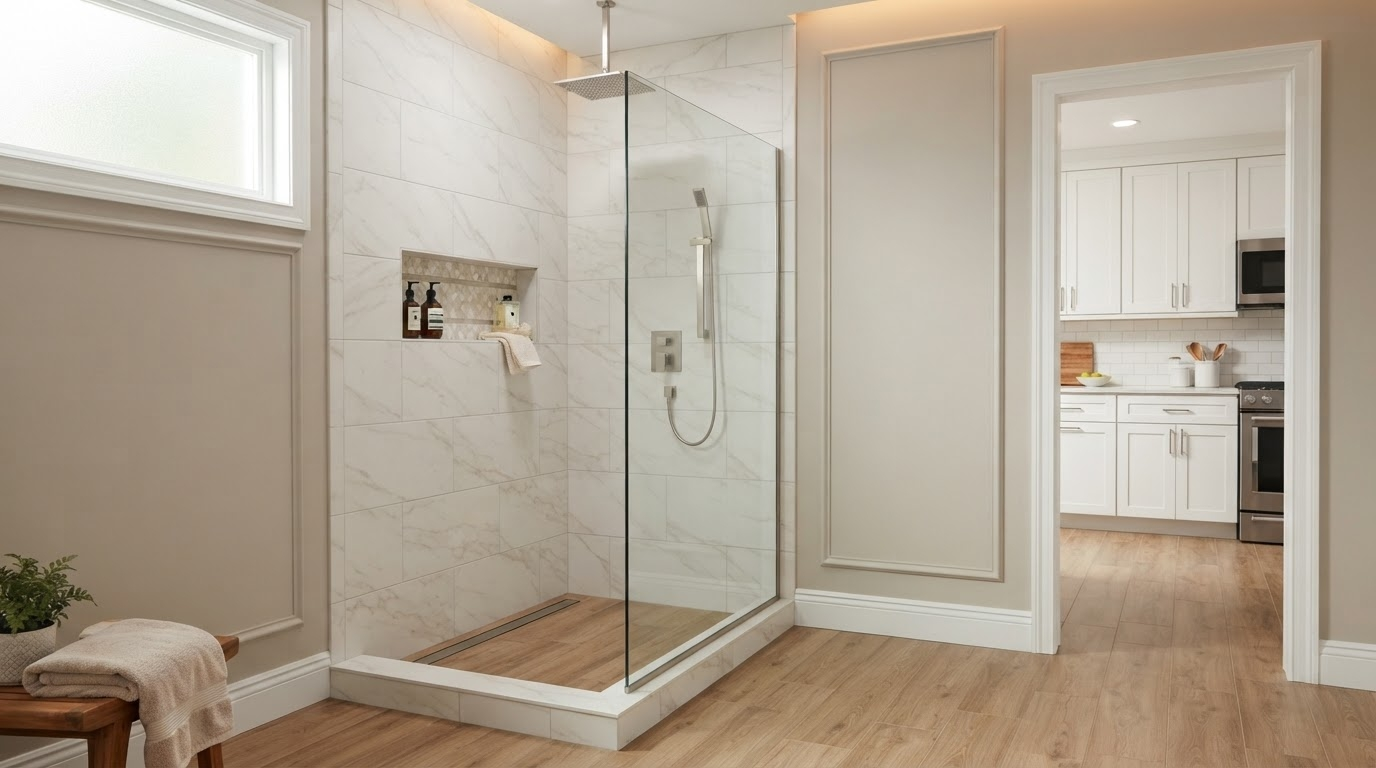
Walk-in showers are the most requested configuration in Tampa Bay bathroom remodeling right now, and tub-to-shower conversions make up a large share of that. Once the tub is gone you have a bigger, more open, more visible space and more tile decisions than you had before.
What works consistently in walk-in showers:
- Large-format walls. Walk-in showers show more wall area than a tub surround ever did. Big tile keeps that expanse calm.
- Mosaic floors. Small-format floor tile conforms to the slope and gives you more grout joints underfoot, which is where you want them.
- A single accent wall. The back wall is the one you see through the glass from the doorway. That is the surface worth spending on.
- A tiled niche. Line it in an accent tile to add a deliberate detail. Set the height before framing it cannot be moved later.
- A linear drain. A linear drain allows a single-direction slope, which lets larger floor tile work and pairs naturally with curbless entries.
- Frameless glass. It puts the tile on display, which is the point of choosing it carefully.
- Curbless entry where the structure allows. Easier access now, and easier access in twenty years.
One planning note that saves regret: decide on the niche, the bench, and any grab bar blocking before framing is closed up. All three are simple during construction and expensive afterward. Even if you do not want a grab bar today, having solid blocking behind the wall costs almost nothing now and gives you the option later.
Shower Floor Tile: What Changes Underfoot
A shower floor is doing three jobs that the walls are not: it is wet constantly, you stand on it, and it has to move water to a drain. Tile that is perfect on a wall can be a poor choice on the floor.
- Slip resistance. Texture and grout joints both contribute to traction. Manufacturers publish slip-resistance data for their products ask for it and follow it rather than relying on how a tile feels dry in a showroom.
- Tile size. Smaller tile conforms to a sloped floor more easily. Large tile on a multi-directional slope requires cuts or a linear drain to work properly.
- Grout joints. More joints means more traction underfoot. This is the one place in a shower where extra grout is a feature.
- Slope. The floor must be sloped consistently toward the drain. Water that pools is a sign of a slope problem, not a tile problem.
- Drainage. A center drain needs slope from four directions. A linear drain along one wall or the entry needs slope from one which makes larger floor tile viable.
- Manufacturer specification. Confirm the specific product is approved for shower floor use. Not all wall tile is.
Waterproofing: What Is Behind the Tile Matters Most
Tile and grout are not waterproof. Grout is porous and water passes through it. What keeps water out of your walls and framing is the waterproofing system installed behind the tile and you will never see it once the job is done.
This is where remodeling projects fail quietly. A shower can look beautiful for two or three years while water moves steadily into the wall cavity behind it. By the time a stain appears on the other side of the wall, the repair is no longer a tile repair. In Tampa's humidity, a wall cavity that gets wet does not dry out on its own.
A properly built shower addresses all of the following:
- Waterproofing membrane. A continuous barrier sheet or liquid-applied over the entire wet area, installed to the manufacturer's system requirements.
- Shower pan. Correctly sloped and sealed, tied into the drain assembly without gaps.
- Corners and seams. Inside corners, changes of plane and seams are the most common failure points and need reinforcement.
- Niches. A niche is a hole cut into a waterproofed wall. It has to be waterproofed as its own assembly and sloped slightly so water drains out.
- Drain connection. The membrane must bond to the drain properly. A gap here defeats everything else.
- Substrate. Cement board or an approved backer never standard drywall in a wet area installed flat and secure.
- Slope. Consistent fall to the drain across the whole floor, with no low spots.
The industry standards here come from the Tile Council of North America and the National Tile Contractors Association, with membrane performance covered under ANSI specifications. You do not need to learn them. You do need a contractor who follows them, and who can tell you which system they are installing and why.
Tampa Shower Tile Color Trends
Color is where trends do the most damage, because the surfaces are large and replacing them is expensive. The useful distinction is not "in" versus "out" it is which colors have held up for decades and which are having a moment.
Timeless choices
- Warm white - the most flexible base color available; works with every fixture finish
- Beige and cream - soft, restful, and forgiving of hard-water spotting
- Greige - the practical middle ground between warm and cool
- Natural stone tones - limestone, travertine and marble palettes have outlasted every trend cycle
- Soft gray - still works when it leans warm rather than blue
Trend-forward choices
- Sage and muted green - currently very popular; best used as an accent
- Muted blue - appealing in coastal homes, but saturated versions date quickly
- Earth tones - terracotta and clay tones are having a strong moment
- Deep charcoal - dramatic, and heavy if used across every surface
Keep the big surfaces timeless and put the trend in a place you can change. A sage niche, a terracotta accent band, a charcoal floor - each of those can be swapped in a weekend project years from now. A full shower in this year's color cannot.
How to Mix Multiple Shower Tiles
Most shower designs that go wrong go wrong here. Homeowners find five tiles they love and try to use all five. The fix is a simple limit.
1 Main Tile + 1 Supporting Tile + 1 Accent
Three combinations built on that formula:
- Modern spa: Large-format warm white porcelain walls, charcoal hexagon floor, fluted white tile in the niche.
- Coastal transitional: Sand-toned 12x24 walls, warm white mosaic floor, muted sea-glass tile in the niche.
- Organic modern: Limestone-look greige walls, wood-look plank floor, zellige-inspired cream tile on the back wall.
Then coordinate the rest of the room:
| Element | Guideline |
|---|---|
| Grout | Close to the tile color on walls. Slightly darker on floors, where it will show wear. |
| Fixtures | Pick one metal finish and repeat it. Two is a deliberate choice; three is a mistake. |
| Vanity | Should relate to the main tile, not compete with the accent. |
| Countertop | Echo the main tile's undertone. Warm tile with a cool countertop reads as a mismatch. |
| Niche | Either the accent tile, or the same tile as the walls. Never a third unrelated material. |
| Lighting | Warm bulbs with warm tile. Cool light makes beige and cream look dirty. |
Common Shower Tile Mistakes
These come up repeatedly, and every one of them is avoidable at the planning stage.
- Choosing tile only on looks. A tile has to survive daily water, daily cleaning, and years of Florida humidity. Appearance is one criterion of several.
- Ignoring wet-area specifications. Not all tile is rated for shower use, and wall-rated tile is not automatically floor-rated. The technical data sheet is the authority.
- Using too many patterns. Two competing patterns in one shower make the room feel smaller and busier. One pattern, one focal point.
- Picking materials you will not maintain. If resealing natural stone on a schedule is not realistic for your household, choose a material that does not require it.
- Poor grout selection. Grout color changes the entire look, and grout type affects stain resistance. It is a design decision, not an afterthought at the end of the job.
- Ignoring shower slope. Standing water means the slope is wrong. It will not correct itself, and it is not something tile choice can fix.
- Skipping or shortcutting waterproofing. The most expensive mistake on this list, and the one you cannot see until the damage is done.
- Overusing trends. This year's color on all four walls is next decade's renovation. Trends belong in accents.
- Ordering too little tile. Cuts, waste and breakage all consume material, and patterns like herringbone consume more. Dye lots vary between production runs, so a mid-job reorder may not match. Order the overage.
- Forgetting the niche. Storage has to be planned before framing closes. Skip it and you will hang a caddy on a shower you just spent thousands on.
What Drives Shower Tile Cost
Tile pricing varies enormously, and the tile itself is often not the biggest line item. These are the factors that actually move a shower tile budget:
- Tile price per square foot - the range between entry-level ceramic and premium large-format porcelain is wide
- Shower size - total square footage of wall and floor
- Tile format - very large panels need more labor and sometimes a second installer to handle
- Pattern complexity - herringbone and intricate layouts add cutting time and material waste
- Demolition - removing an existing tub or tile surround, and disposal
- Waterproofing system - materials and the labor to install them correctly
- Substrate repairs - older Tampa homes often reveal issues once the wall is opened
- Niches and benches - each is a separate framed, waterproofed, tiled assembly
- Drain changes - converting to a linear drain or a curbless entry involves plumbing work
- Labor and installer skill - the largest variable, and the one least worth economizing on
- Material availability - special-order and imported tile can carry long lead times
For broader planning context, our guide to what a bathroom remodel costs in Tampa breaks down full project ranges. Any figure you find online is a starting point for a conversation, not a quote - the only accurate number comes from someone who has seen your bathroom.
How to Choose a Tampa Bathroom Remodeling Contractor
Tile is visible. Waterproofing is not. That gap is exactly why choosing the right contractor matters more here than in almost any other room of the house. Use this checklist:
- Florida licensing. Verify the license number directly through the state, not just on a website. Ours is CGC #1537706.
- Insurance. Ask for current certificates of general liability and workers' compensation coverage.
- Local experience. Tampa Bay homes have their own patterns slab foundations, older plumbing, humidity. Local track record matters.
- Portfolio. Look for completed bathrooms similar to yours, in homes like yours.
- Waterproofing process. Ask them to describe the system by name and explain how it is installed.
- Tile installation experience. Large-format and complex patterns require specific skill. Ask what they have done.
- Written estimate. Itemized, so you can see exactly where the money goes.
- Material specifications. The exact tile, grout and membrane should be named in the contract.
- Warranty. Get the workmanship warranty in writing, separate from the manufacturer's material warranty.
- References. Ask for recent local clients - and actually call one or two.
"What waterproofing system will be installed behind my shower tile?"
A contractor who answers specifically and confidently has thought about it. A contractor who deflects to how good the tile will look has told you something important.
Choosing With Confidence
The best shower tile ideas are the ones that still look right to you in ten years and that hold up to a decade of Florida humidity in the meantime. That usually means keeping the large surfaces calm and neutral, letting one accent carry the personality, choosing materials that match how much upkeep you will realistically do, and making sure the waterproofing behind everything was installed by someone who takes it seriously.
Get those four things right and the tile you pick will be a decision you feel good about every morning.
For over a decade, Remodels by Renov8 Plus has helped Tampa Bay homeowners plan and build bathrooms they are proud of - from South Tampa and Hyde Park to Carrollwood, Westchase, Wesley Chapel, Clearwater and St. Petersburg.
Schedule a bathroom remodeling consultation and we will walk through shower tile ideas, layouts, materials, waterproofing and installation options together. You will get a dedicated project manager, a clear written scope, and honest guidance on what makes sense for your home and budget - with no pressure.
Licensed and insured Florida contractor · CGC #1537706 · Design-build from first sketch to final walkthrough
Get Your FREE Estimate - Call (656) 232-0999
3750 Gunn Hwy, Unit 306, Tampa, FL 33618
Phone: (656) 232-0999 · Email: info@renov8plus.com
Web: renov8plus.com · License: CGC #1537706
Mon–Fri 9AM–7PM · Sat 10AM–3PM · Closed Sunday