
Florida's bathrooms operate under conditions that materials in most other states never face. Between year-round humidity that rarely drops below 70%, daily shower moisture, condensation on cool surfaces, and the kind of sustained water exposure that comes with subtropical living, your material choices matter far more here than in a dry climate. Choosing the best bathroom materials for Florida humidity is not optional, it is essential.
But material selection alone does not solve the moisture problem. A porcelain tile wall installed over an improperly waterproofed shower will fail just as surely as a cheap particleboard vanity placed next to a running shower. The complete system matters: proper ventilation, correct installation, adequate waterproofing, appropriate material selection, and ongoing maintenance all work together to keep a Florida bathroom performing well for years.
This guide walks through every major bathroom material category, including tile, flooring, cabinets, countertops, shower surfaces, and grout, and explains what performs well in a Florida humidity bathroom, what can fail, and why the distinction often comes down to how materials are installed and maintained rather than the material alone.
What Are the Best Bathroom Materials for Florida Humidity?
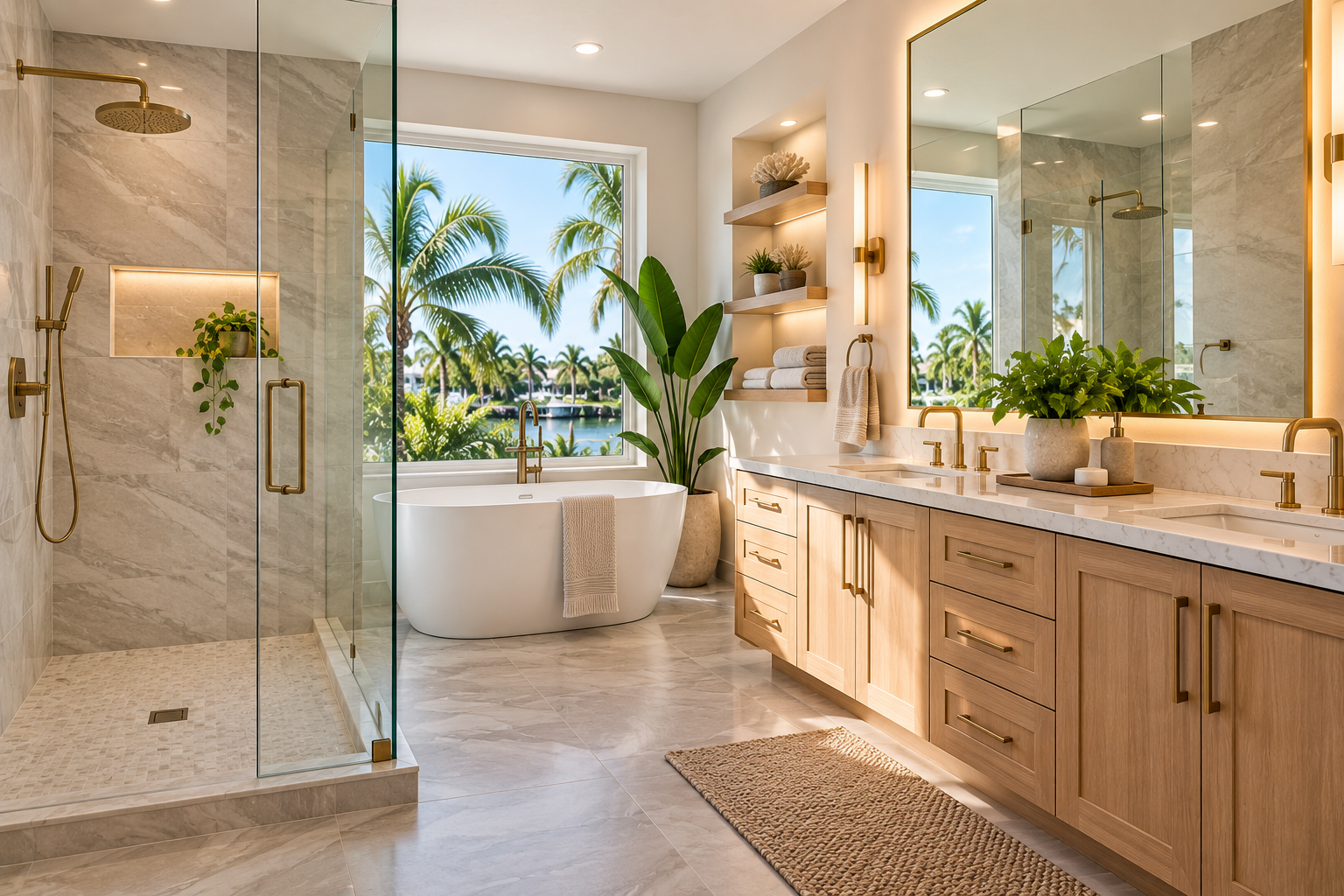
The best bathroom materials for Florida humidity include porcelain tile for floors, walls, and showers due to its low water absorption rate; quartz countertops for moisture and stain resistance; plywood-core cabinetry with sealed edges and moisture-resistant finishes; and epoxy or high-performance grout. However, material performance in humid conditions also depends on proper waterproofing, installation quality, bathroom ventilation, and regular maintenance.
Why Does Florida Humidity Matter in Bathroom Remodeling?
Tampa Bay's average relative humidity hovers between 70% and 80% throughout the year. Inside a bathroom, that baseline humidity combines with hot shower steam, splashing water, and condensation to create one of the most moisture-intensive environments in any home.
This sustained moisture affects bathroom materials in several ways:
- CondensationForms on cool surfaces such as mirrors, countertops, walls, and even inside cabinets, creating persistent dampness that accelerates material degradation.
- Water vaporPenetrates porous and semi-porous materials, causing swelling, warping, and delamination over time.
- Mold and mildewThrive in warm, damp conditions, and Florida bathrooms provide exactly that environment year-round.
- Expansion and contractionFrom temperature and moisture cycling, which stresses joints, seams, and adhesive bonds.
- Moisture trapped behind finishesBehind tile, under flooring, inside walls, where it can cause invisible damage that becomes expensive to repair.
Is Porcelain Tile Good for Florida Bathrooms?
Porcelain tile is one of the best bathroom materials for Florida humidity and the most frequently specified tile in Tampa Bay bathroom remodels. Its water absorption rate falls below 0.5%, which means the tile body itself absorbs virtually no moisture, making it well-suited for shower walls, shower floors, bathroom floors, and wet-area walls.
Porcelain is available in a wide range of formats and finishes: large-format tiles (24x24 and larger) create seamless modern surfaces with fewer grout lines to maintain, wood-look porcelain planks provide warmth without moisture vulnerability, and stone-look porcelain delivers the aesthetics of marble or travertine without the sealing requirements.
The caveat: porcelain tile is only as good as its installation. In a shower, the waterproofing membrane behind the tile is what actually prevents water intrusion; the tile itself is the visible surface, not the moisture barrier. Grout between tiles also requires maintenance, especially in humid conditions where mildew can develop on cement-based grout surfaces without regular cleaning.
Is Ceramic Tile Good for Humid Florida Bathrooms?
Ceramic tile is a practical and affordable choice for bathroom walls, backsplashes, and decorative accents. It offers tremendous design flexibility, available in virtually any color, size, and pattern, and performs well in moderate moisture exposure when properly installed.
The key difference between ceramic and porcelain is density and water absorption. Ceramic tile typically has a higher water absorption rate (generally above 0.5%) because it is fired at lower temperatures than porcelain. This makes ceramic more suitable for walls and areas with indirect water exposure rather than shower floors or surfaces that receive sustained direct water contact.
For Florida bathrooms, ceramic tile works well on walls, as wainscoting, behind vanities, and as accent surfaces. For shower walls and floors where constant water exposure is a factor, porcelain is generally the more durable choice.
Does Natural Stone Work in a Florida Bathroom?
Natural stone, including marble, travertine, limestone, and granite, brings undeniable beauty and character to a bathroom. But in Florida's humid climate, stone requires more attention than many homeowners expect.
Most natural stones are porous to some degree. Marble and limestone are particularly absorbent, which means they can stain, etch, and harbor moisture if not properly sealed and maintained. Travertine has natural voids that can trap water. Granite is denser and generally more moisture-resistant, but still benefits from periodic sealing.
Natural stone can work well in a Florida bathroom under the right conditions:
- Professional-grade sealing applied at installation and reapplied on a regular maintenance schedule
- Appropriate application - stone on a vanity wall or feature accent rather than a shower floor
- Consistent maintenance - stone-safe cleaners, prompt attention to standing water, and no acidic products
- Realistic expectations - stone patinas over time, and that character is part of the appeal for many homeowners
Best Bathroom Flooring for Florida Humidity
The bathroom floor takes constant punishment in a humid climate: water splashes, steam, bare feet, cleaning products, and condensation dripping from surfaces above. Here is how the most common bathroom flooring materials compare in Florida conditions.
Porcelain Tile Excellent
- Moisture performance
- Excellent - under 0.5% absorption
- Maintenance
- Low - regular cleaning, grout care
- Design options
- Wide range: stone, wood, concrete looks
- Key consideration
- Best all-around choice for FL bathrooms
Ceramic Tile Good
- Moisture performance
- Good - higher absorption than porcelain
- Maintenance
- Low to moderate
- Design options
- Wide range of colors and patterns
- Key consideration
- Better for low-splash areas
Natural Stone Moderate
- Moisture performance
- Moderate - requires sealing
- Maintenance
- Higher - sealing, stone-safe cleaners
- Design options
- Unique, luxury appearance
- Key consideration
- Ongoing sealing and maintenance essential
Luxury Vinyl Plank Good
- Moisture performance
- Good - waterproof surface layer
- Maintenance
- Low
- Design options
- Wood and stone looks available
- Key consideration
- Quality varies; check wet-area ratings
Hardwood Poor
- Moisture performance
- Poor - absorbs moisture, swells
- Maintenance
- High - not recommended for wet areas
- Design options
- Warm, natural appearance
- Key consideration
- Not suitable for FL bathroom floors
For most Florida bathrooms, porcelain tile remains the safest and most durable flooring choice. It handles humidity, water exposure, and daily wear without the maintenance burden of stone or the moisture vulnerability of wood. For a wider look at flooring in this climate, see our guide to the best flooring for Florida humidity and our waterproof bathroom flooring options guide.
Best Bathroom Cabinet Materials for Florida Humidity
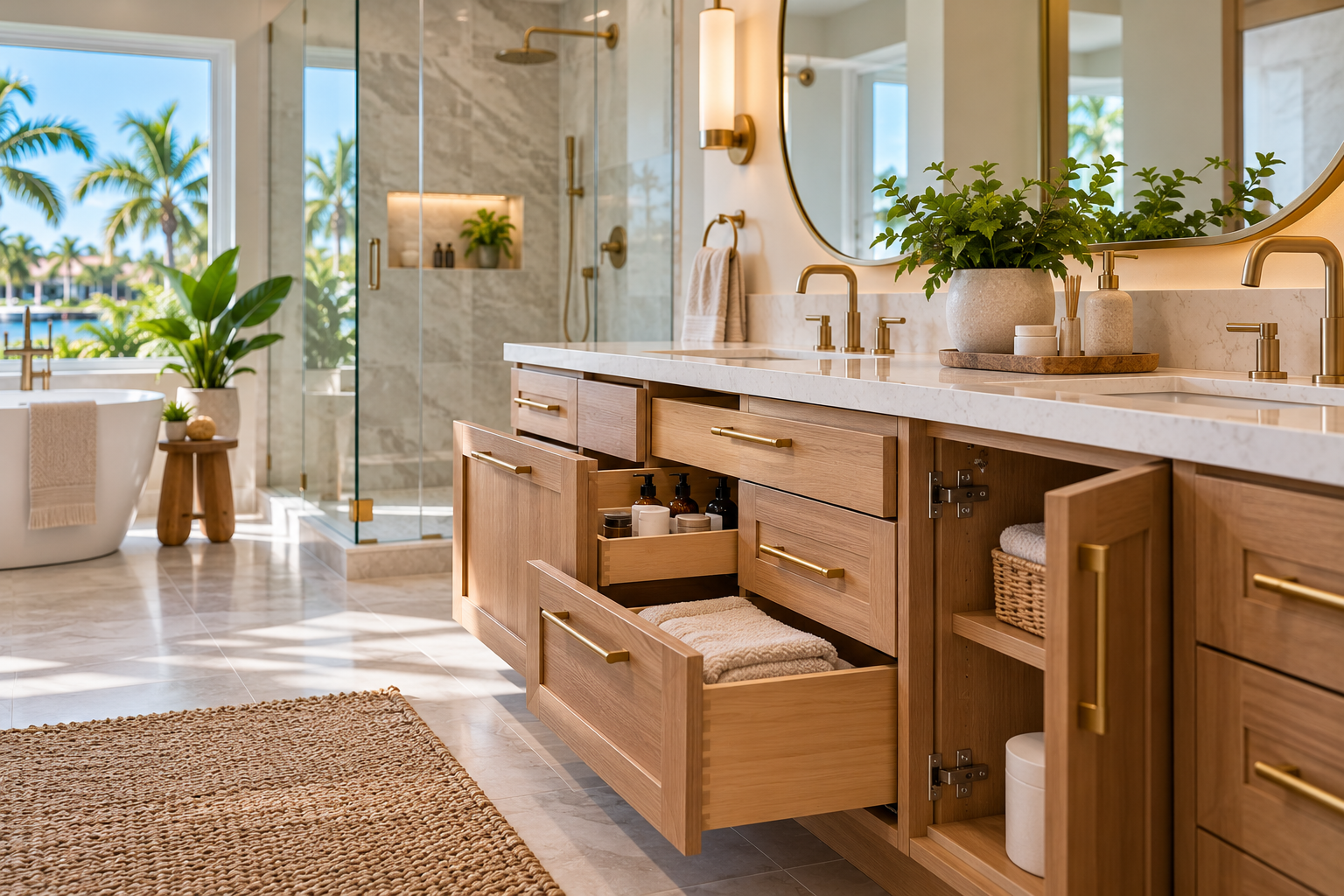
Bathroom cabinets in Florida face a unique challenge: they sit in one of the most humid rooms in the house, often directly adjacent to sinks and showers where water splashes are constant. The wrong cabinet material can swell, warp, delaminate, or develop mold within a few years.
Here is what to look for when selecting mold resistant bathroom materials for cabinetry:
- Plywood-core construction resists moisture far better than particleboard or MDF. Plywood's layered structure gives it dimensional stability that solid-particle products lack.
- Solid wood performs well when properly finished and sealed, but raw or poorly finished wood absorbs moisture and can warp. Marine-grade finishes improve performance.
- MDF (medium-density fiberboard) is commonly used for cabinet doors because it machines smoothly and paints beautifully, but it absorbs water aggressively when edges or surfaces are unsealed. In a Florida bathroom, MDF should only be used on well-sealed, non-contact surfaces.
- Particleboard is the most moisture-vulnerable cabinet material. When exposed to water, even humid air over time, it swells irreversibly. It is the leading cause of bathroom cabinet failure in Florida homes.
- Thermofoil and laminate finishes provide a moisture-resistant exterior, but if water reaches unsealed edges or penetrates the finish through chips or damage, the substrate underneath can still fail.
Best Bathroom Countertop Materials for Humid Florida Homes
Bathroom countertops face daily water exposure from hand washing, splashing, and the ambient humidity that coats every surface in a Florida bathroom. The right countertop material should resist moisture, staining, and mildew without demanding constant maintenance.
Quartz Excellent
- Moisture resistance
- Excellent - non-porous
- Maintenance
- Very low - no sealing needed
- Appearance
- Wide range of colors and patterns
- Best for
- Most FL bathroom applications
Granite Good
- Moisture resistance
- Good - dense, but porous
- Maintenance
- Moderate - periodic sealing
- Appearance
- Natural stone character
- Best for
- Vanities with proper sealing
Porcelain Slab Excellent
- Moisture resistance
- Excellent - very low absorption
- Maintenance
- Very low
- Appearance
- Stone and concrete looks
- Best for
- Modern, low-maintenance vanities
Solid Surface Very good
- Moisture resistance
- Very good - non-porous
- Maintenance
- Low - repairable surface
- Appearance
- Seamless, uniform appearance
- Best for
- Integrated sink applications
Marble Lower
- Moisture resistance
- Lower - porous, etches
- Maintenance
- Higher - sealing, careful cleaning
- Appearance
- Classic luxury appearance
- Best for
- Low-use powder rooms, accents
Quartz is the most popular bathroom countertop in Tampa Bay remodels for good reason: it is non-porous, requires no sealing, resists staining, and handles Florida's humidity without degradation. Granite works well when sealed. Marble is beautiful but demands the most care.
Best Shower Materials for a Humid Climate
The shower is the single most moisture-intensive zone in any bathroom. Every surface inside a shower enclosure faces direct and sustained water exposure, steam, and the temperature fluctuations that come with daily use. In a humid climate bathroom design, the shower demands the most careful material and installation decisions.
Materials commonly used inside showers include:
- Porcelain tile - the standard choice for shower walls and floors, offering low absorption, design versatility, and long-term durability
- Ceramic tile - suitable for shower walls in many applications, though porcelain is preferred where standing water is persistent
- Large-format tile - reduces grout joints, creating a more seamless and easier-to-maintain shower surface
- Natural stone - can be used for feature walls and accents when properly sealed, but requires ongoing maintenance
- Solid-surface panels - provide a grout-free shower surface that simplifies cleaning and eliminates grout maintenance
Shower niches, benches, and corners deserve particular attention. These transition points are where water intrusion most commonly occurs, not through the tile, but through improperly sealed joints and transitions in the waterproofing system behind the tile. For design direction, see our shower tile ideas for Tampa Bay.
Grout: What Florida Homeowners Should Know
Grout is often an afterthought in bathroom design, but in Florida's humid climate, it is one of the most maintenance-critical components of any tile installation.
- Cement-based grout is the most common type. It is porous, which means it can absorb moisture, stain, and develop surface mildew if not sealed and cleaned regularly. In a Florida bathroom, cement grout should be sealed after installation and resealed periodically.
- Epoxy grout is non-porous, stain-resistant, and significantly more resistant to moisture penetration than cement grout. It costs more and requires more skill to install, but it dramatically reduces grout maintenance in humid environments.
- High-performance modified grout products offer a middle ground, with better moisture resistance than standard cement grout without the installation complexity of full epoxy.
No grout is entirely maintenance-free. Even epoxy grout develops surface film and mildew in a poorly ventilated Florida bathroom. The best grout performance comes from the combination of the right product, correct installation, adequate ventilation, and regular cleaning.
Why Waterproofing Matters More Than the Tile
This is the most important section of this guide. The tile you see on your shower walls is not what keeps water out of your walls. The waterproofing membrane behind the tile is.
A properly waterproofed shower includes:
- A continuous waterproofing membrane applied to the substrate before any tile is installed
- Sealed seams and transitions at every corner, niche, bench, and floor-to-wall junction
- Waterproofed penetrations around plumbing fixtures, showerheads, and valves
- A properly sloped shower pan that directs water to the drain
- Integration between the shower pan waterproofing and the wall membrane
When evaluating a bathroom contractor, ask specifically about their waterproofing method and materials. This is not a place to cut costs.
How to Reduce Mold and Mildew Risk in a Florida Bathroom
Mold and mildew are not just cosmetic problems; they are health concerns and property damage risks. Florida's warm, humid conditions make bathrooms particularly susceptible. Here is how to minimize the risk:
- Install a properly sized exhaust fan and run it during and for 20-30 minutes after every shower.
- Ensure the exhaust fan vents to the exterior, not into the attic, where it creates a secondary moisture problem.
- Choose moisture-tolerant materials throughout the bathroom: porcelain tile, quartz countertops, plywood-core cabinetry.
- Maintain waterproofing integrity behind shower tile and around plumbing penetrations.
- Clean surfaces regularly to prevent mildew buildup on grout, caulk, and fixtures.
- Address plumbing leaks immediately, since even small drips create sustained moisture that feeds mold.
- Seal cement-based grout and reseal on the manufacturer's recommended schedule.
- Keep bathroom doors or windows open after use when possible to promote air circulation.
Selecting mold resistant bathroom materials is one layer of protection, but it is not the only layer. Mold prevention is a system: ventilation, waterproofing, material selection, installation quality, and maintenance all work together.
Bathroom Materials That May Cause Problems in Florida Humidity
Material failure in a Florida bathroom is rarely caused by a single factor. It is almost always the combination of the wrong material, poor installation, inadequate moisture management, or deferred maintenance. Here are conditions that commonly create problems:
- Particleboard cabinets exposed to humidity or water splash - swelling and delamination are irreversible
- Unsealed MDF edges on cabinet doors, shelving, or trim - moisture wicks into exposed edges rapidly
- Porous natural stone installed without sealing or without a regular resealing schedule
- Improperly waterproofed showers - the most expensive failure, often invisible until damage is severe
- Hardwood flooring in bathrooms - wood absorbs moisture, swells, cups, and eventually warps in Florida's humidity
- Cement grout without sealing in high-moisture areas - staining, mildew, and deterioration
- Materials installed outside their rated application - wall-only tile used on shower floors, non-wet-area products in wet zones
- Inadequate ventilation - even the best materials degrade faster without proper exhaust and airflow
The takeaway: most material failures are preventable. Choose appropriate materials, install them correctly, waterproof wet areas properly, ventilate the room, and maintain surfaces on a reasonable schedule.
Bathroom Material Comparison: Florida Humidity Performance
Florida Humidity Material Ratings
Eleven common bathroom materials rated for humid-climate performance
Best Coastal Bathroom Materials for Florida Homes
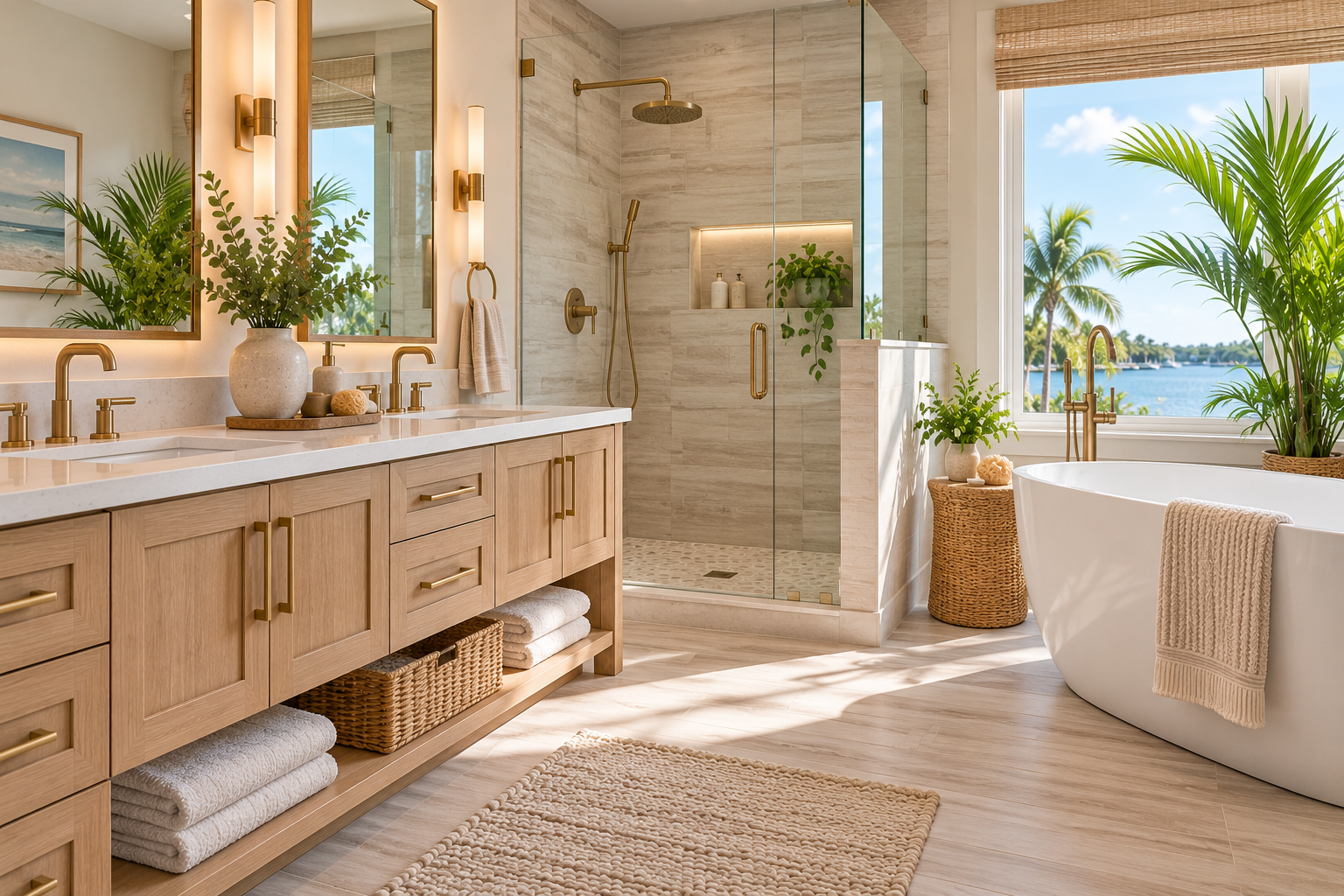
Creating a coastal bathroom look in a Florida home is one of the most popular design directions, and it works naturally because the design aesthetic and the climate-appropriate material palette overlap.
Coastal bathroom materials that perform well in humidity include light-colored porcelain tile in stone or linen textures, warm white subway tile with soft grout tones, wood-look porcelain planks in driftwood and weathered oak finishes, quartz countertops in soft white or sand tones, and natural-texture accessories that reference the coast without demanding high-maintenance materials.
The key to a lasting coastal bathroom is choosing materials for their performance first and their appearance second. A beautiful reclaimed-wood accent wall may look stunning, but if it is not properly sealed and ventilated, it becomes a moisture trap in a Florida bathroom. Light-colored porcelain that mimics whitewashed wood or natural linen achieves the same aesthetic with none of the risk.
Humid Climate Bathroom Design: More Than Choosing Materials
The most successful Florida bathrooms are designed as moisture-management systems, not just collections of attractive surfaces. A humid climate bathroom design considers every layer:
- Ventilation - a properly sized, exterior-vented exhaust fan is non-negotiable
- Waterproofing - continuous membrane systems behind every shower surface, properly integrated at all transitions
- Drainage - correctly sloped shower pans and floors that move water to drains, not into walls or subfloor
- Material selection - low-absorption tile, non-porous countertops, moisture-tolerant cabinetry, and durable finishes
- Installation quality - materials are only as good as the skill behind their installation
- Cleaning and maintenance - regular care extends the life of every material and prevents surface mold
- Leak detection - addressing plumbing leaks quickly prevents hidden moisture damage
- Air circulation - allowing the bathroom to dry between uses reduces sustained humidity on surfaces
When all eight layers work together, a Florida bathroom can look beautiful and perform flawlessly for decades. When any single layer is neglected, even premium materials can fail.
Build a Bathroom That Handles Florida's Climate
Choosing the right materials is the foundation of a bathroom that lasts in Florida's demanding environment. But materials are only part of the equation. Proper installation, waterproofing, ventilation, and craftsmanship are what turn good materials into a great bathroom.
Remodels by Renov8 Plus helps Tampa Bay homeowners design and build bathrooms engineered for Florida's humidity, backed by over 10 years of design-build experience, a dedicated project manager on every project, and a commitment to on-time, on-budget results. Learn more about our bathroom remodeling in Tampa services.